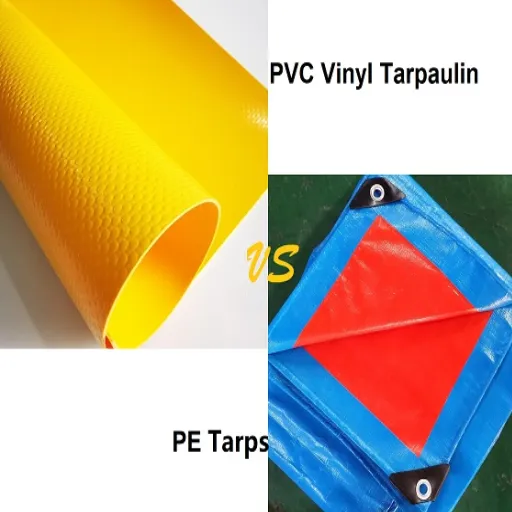
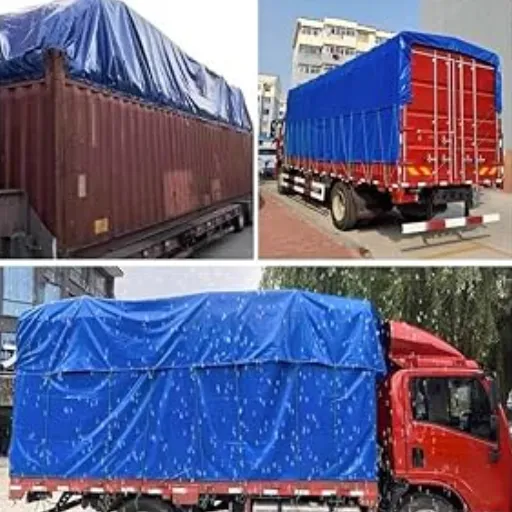
A truck cover waterproof tarpaulin is a particular kind of fabric over crafted to protect products being hauled by a truck from getting wet or getting sabotage. This tends to eliminate the usage of a tarp that is centrally made of PVC or laminated, polyethylene thickness which ranges from 450 to 1,100 GSM with hems and ear stitched and ring vibrators match the dynamic wind loads that the vehicle will encounter while in motion limit the wind flow between the vehicle and trailer helping in the prevention of drag. In sharp contrast to standard tarps, it’s also important that the tarp meet the requirements regarding the positive lawful cargo securement at road transport, their necessity as the wind curtains during the hight speed motorways on average 80km/h or more.
The unfortunate reality that many in the industry come to appreciate far too late is that for a poorly-sized truck tarpaulin or curtain, even one cargo spill can result in a penalty of at least $16,000 that is not inclusive of any other costs. This figure also does not capitalize the loss of goods, tardiness of goods, or defensive risk of falling out of grace with your client. Even so, a lot of customers still purchase truck covers based on the cost of a meter squared while not minding the distance of grommet installation. Neither is the construction of flat or flat panel bulkheads or the strength gsm more light any less than that required of Polestar.
We manufacture waterproof tarpaulin for truck covers for fleets operating worldwide. Over the years, we have seen the same costly mistakes repeat. Buyers specify “heavy-duty” without a GSM number. Fleets replace PE covers annually when a single PVC investment would last five years. Operators discover their tarps are not actually waterproof the first time they drive through sustained monsoon rain. This guide covers everything you need to specify, size, and source truck covers, from regulations and sizing formulas to fleet total cost of ownership. For a broader view of all applications, see our complete guide to tarpaulin uses.
Key Takeaways
- Truck tarpaulins must comply with cargo securement laws (FMCSA 49 CFR §393.100 requires downward force equal to 20% of cargo weight) or risk fines from 1,000to16,000+ per occurrence.
- Sizing formula for flatbeds: Tarp Width = Trailer Width + (2 x Load Height) + tuck-under allowance — most buyers guess and end up with inadequate drop coverage.
- PVC truck tarpaulins at 600–750 GSM typically last 5–7 years in highway service; 200 GSM PE equivalents often require annual replacement, making their total cost of ownership 40–60% higher.
- Highway-rated truck tarps need 50 cm grommet pitch and webbing-reinforced hems to resist wind tearing at motorway speeds.
- Automatic tarp systems reduce driver tarping time from 15–20 minutes to under 2 minutes, paying for themselves on high-frequency routes within 18–24 months.
What Is a Truck Tarpaulin?
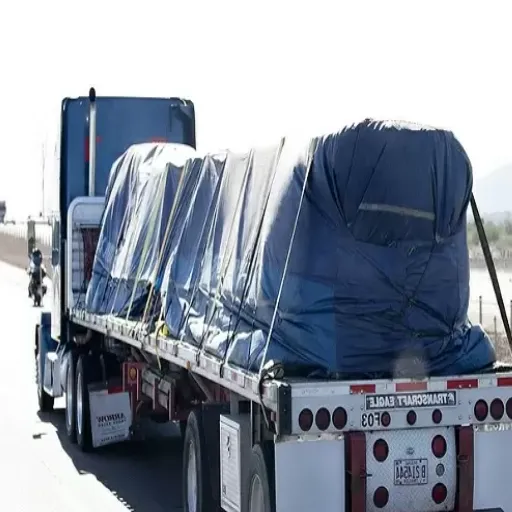
A truck tarpaulin is a purpose-built cargo cover designed to protect freight from weather, road debris, and contamination during transport. It differs from a general-purpose tarpaulin in three critical ways: it must be sized precisely to the trailer and load dimensions, it must withstand sustained wind loads at highway speeds without tearing at anchor points, and it must comply with cargo securement regulations that vary by jurisdiction.
The waterproof barrier in a truck tarpaulin comes from the coating material — typically PVC or laminated polyethylene — applied to a woven polyester or HDPE base fabric. For a deeper explanation of how this waterproof barrier works, what hydrostatic head ratings mean, and how PVC differs from PE at the molecular level, see our complete guide to what makes a tarpaulin truly waterproof.
Truck tarpaulins also feature reinforcement elements that general-purpose tarps often lack. Webbing-reinforced hems distribute stress across the edge rather than concentrating it at stitch lines. Brass or aluminium grommets at 50 cm intervals provide secure tie-down points that resist pull-out under wind load. Corner D-rings or webbing loops add strength where the fabric experiences the highest mechanical stress.
Types of Waterproof Tarpaulin for Trucks
Not all truck tarpaulins serve the same purpose. The type you need depends on your trailer configuration, cargo characteristics, and operating conditions.
Flatbed Truck Tarpaulins
Flatbed tarps fall into three main categories. Lumber tarps feature 6-foot to 8-foot drop flaps on the front and rear to cover tall stacked loads completely. They include a tail flap that hangs below the deck to prevent wind lift. Steel tarps are smaller and lower-profile, designed for steel coils, bars, and plates that do not require full side coverage. They typically measure 16 ft x 20 ft versus 24 ft x 27 ft for lumber tarps. Smoke tarps are narrow covers used over the cab area to protect the front of the load from exhaust soot and road spray.
Dump Truck and Trailer Tarpaulins
Dump truck tarps face a different challenge: they must contain lightweight, aerodynamic materials like sand, gravel, and aggregate that can blow out at speed. Many operators use mesh tarps for aggregates because they allow airflow while containing the load. For weather-sensitive materials like salt or agricultural products, solid PVC tarps with automatic roll systems are standard. The roll mechanism mounts to the trailer and deploys via electric or hydraulic drive, eliminating the need for the driver to climb onto the load.
Curtain-Sider and Side-Curtain Truck Tarpaulins
Curtain-sided trucks use rigid or semi-rigid frames with sliding fabric curtains instead of solid walls. The tarpaulin material here functions as both cover and access panel. These curtains typically use 650–900 GSM PVC with RF-welded seams and reinforced slide rails. Because they open and close multiple times per day, abrasion resistance at contact points matters more than absolute waterproofing.
Refrigerated and Specialty Truck Covers
Refrigerated trucks sometimes need insulated tarpaulin covers for multi-temperature loads or during breakdown recovery. Specialty applications — such as hazardous material transport — may require flame-retardant certification to DIN 4102, NFPA 701, or EN 13501-1 standards.
If you have any questions or need further assistance, don’t hesitate to get in touch with us.
Truck Tarpaulin Sizes: How to Measure Waterproof Tarpaulin for Truck Covers
Getting the size wrong is one of the most common and expensive mistakes in truck tarpaulin procurement. A tarp that is too small leaves cargo exposed. A tarp that is too large creates wind flaps that increase drag and tearing risk.
The Sizing Formula for Flatbed Loads
For flatbed applications, use this formula:
Tarp Width = Trailer Width + (2 x Load Height) + Tuck-Under Allowance
The tuck-under amount is in general 0.5-1 metres per side, depending on the necessity to secure the tarp under the trailer. For a normal 8-foot load on a 102-inch flatbed trailer, the obtained figure equates to nearly 7.3 metres tarp width.
Consider this case before judging. Marcus, a male fleet manager of a timber exporting company in Malaysia, found his flatbed load to be 2.4m by 2.1m. Given these dimensions, the tarps were made as 4.5m – slightly wider than what he had calculated, and allowed for a 0.8m tuck-under for both sides. The tarp covers the whole area with some overlap to clamp it under the tension straps without any flapping of the tarp due to wind. The former tarp supplier had dispatched 3.8 metre long tarping sheets that exposed the bottom ends in a wetty weather. He might have to put up with a few weeks of water dripping from the roof and winter snowstorms, but he would not give another opportunity to the dripping rain.
Dump Truck and Trailer Dimensions
Dump truck tarp sizing depends on the roll system or frame configuration rather than a simple formula. Measure the inside width of the trailer box, the length from cab shield to tailgate, and the maximum height of the load when the box is level. Most dump truck roll tarps are custom-fabricated to these exact dimensions with a 5–10 cm overlap margin.
Custom Sizing for Irregular or Oversized Loads
Oversized loads — wind turbine blades, heavy machinery, prefabricated structures — require custom tarpaulin fabrication with irregular shapes, extended drop panels, or multiple sections. In these cases, a dimensioned drawing is essential. We recommend submitting a sketch with length, width, height, and any cut-outs or special anchor points clearly marked. For standard dimensions, see our tarpaulin sheet size guide.
| Truck Type | Typical Tarp Dimensions | Recommended GSM | Key Features |
|---|---|---|---|
| Standard Flatbed | 7.3 m x 8.2 m (24 ft x 27 ft) | 600–750 | Webbing-reinforced hem, 50 cm grommet pitch |
| Lumber Flatbed | 7.3 m x 8.2 m + 2.4 m drops | 750–900 | 8-foot front and rear flaps, tail flap |
| Steel Hauler | 4.9 m x 6.1 m (16 ft x 20 ft) | 600–750 | Low profile, corner pockets |
| Dump Truck | Custom to box dimensions | 450–650 | Roll-system compatible, mesh or solid |
| Curtain-Sider | Custom to frame width | 650–900 | RF-welded seams, slide-rail reinforced |
| Heavy-Duty Long-Haul | Custom | 900–1,100 | Full reinforcement, UV inhibitors, FR option |
Truck Tarpaulin Regulations and Compliance
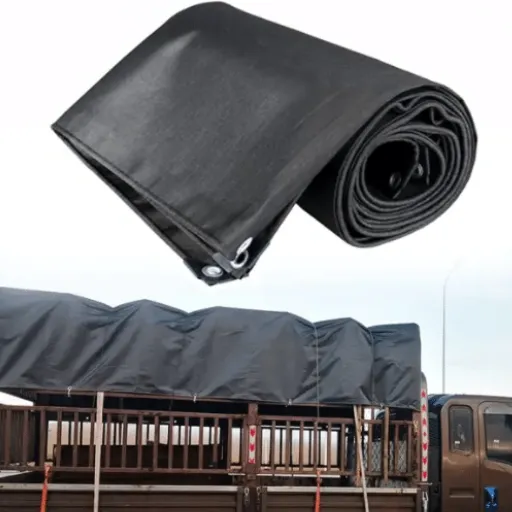
Cargo securement regulations exist for good reason: unsecured or improperly covered cargo kills people. Understanding the rules that apply to your operating region is not optional — it is a legal and moral obligation.
U.S. FMCSA Cargo Securement Rules
The Federal Motor Carrier Safety Administration’s 49 CFR §393.100 mandates that all cargo on commercial motor vehicles must be secured to prevent leaking, spilling, blowing, or falling from the vehicle. The regulation requires a downward force equal to 20% of the cargo weight to prevent vertical displacement. For tarpaulin-covered loads, this means your tie-down system — including the tarpaulin anchor points — must contribute to or not compromise that retention force.
FMCSA violations carry fines ranging from 1,000toover1,000toover16,000 per occurrence, depending on severity and whether the violation contributed to an incident. In 2023, cargo securement violations ranked among the top 10 most common out-of-service violations during roadside inspections.
European and International Standards
Within the European Union, cargo securement falls under EN 12195-1, the European standard for load restraint on road vehicles. While individual member states enforce their own penalties, the underlying principle mirrors FMCSA: cargo must be secured against all foreseeable forces during normal transport conditions, including braking, cornering, and acceleration.
For international transport under the TIR Convention, tarpaulin seals may form part of the customs security system. Tarpaulins used for TIR operations must be tear-resistant and feature a sealable closure system that customs authorities can inspect and lock.
Hazardous Materials and Special Cargo Requirements
Transport of hazardous materials introduces additional tarpaulin requirements. In the United States, the Pipeline and Hazardous Materials Safety Administration (PHMSA) mandates that hazardous material packages must be protected from weather and damage. For open vehicles, this typically means a fully enclosed waterproof cover. Many jurisdictions also require flame-retardant tarpaulin materials for certain hazardous cargo classes. For detailed flame-retardant specifications and certification requirements, refer to our flame-retardant tarpaulin specifications.
Waterproof Tarpaulin for Truck Covers: Materials and Specs
The material you choose determines how long your truck tarpaulin lasts, how well it performs in your climate, and what your true cost of ownership works out to over time.
Recommended GSM by Truck Type and Duty Cycle
GSM — grams per square metre — is the most important number on a truck tarpaulin specification sheet. It tells you how much material is in the fabric, which correlates directly with tear strength, abrasion resistance, and service life. For a complete GSM selection framework across all applications, see our GSM selection guide for heavy-duty waterproof tarpaulin.
For truck applications specifically, here are the practical ranges:
- Light commercial vehicles (pickups, small delivery trucks): 450–550 GSM PVC. Sufficient for occasional use and lower wind loads.
- Standard fleet flatbeds (regional haul, moderate mileage): 600–750 GSM PVC. The sweet spot for most operators — durable without excessive weight.
- Heavy-duty long-haul fleets (high mileage, extreme climates): 900–1,100 GSM PVC. Maximum durability for operators who cannot afford downtime.
For a complete overview of our heavy-duty tarpaulin range and how it performs across industries, see our dedicated product page.
Why PVC Dominates Truck Applications
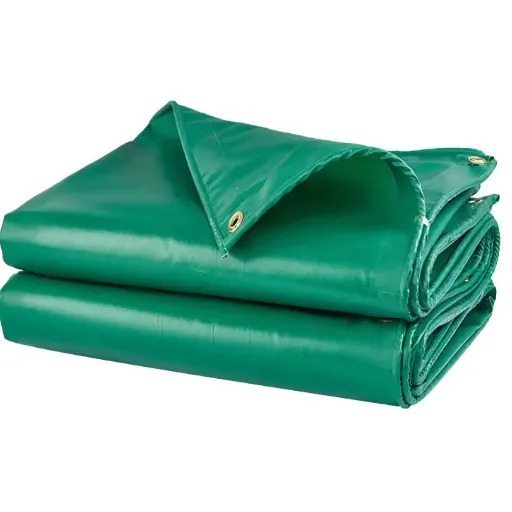
PVC coated polyester has become the standard for commercial truck tarpaulins for several reasons. It is 100% waterproof (not merely water-resistant), it can be RF-welded into seamless panels that do not leak at stitch holes, and it maintains flexibility across a wide temperature range — typically -30°C to +70°C for standard formulations. PVC also accepts UV inhibitors, flame retardants, and colour pigments without compromising the base waterproof barrier.
For a detailed technical breakdown of PVC tarpaulin construction, coating processes, and quality standards, see our PVC waterproof tarpaulin guide.
Polyethylene tarpaulins have a place in trucking — primarily for short-term or single-trip coverage where cost matters more than longevity. But for fleet operators running repeated routes, the replacement cycle on PE makes it the more expensive choice over time.
Wind Resistance and Reinforcement Essentials
Generally, the main factor that determines the length of time they will serve is the reinforcing elements one has used. And grommet pitch while installing them turns out to be a key aspect in the achievement of such different standards: 50 cm (20-inch) for duty truck tarpaulins, and for general tarps, it is mostly not more than 100 cm (39-inch). The uniform distribution of wind across these grommets is beneficial in that it eliminates the “sail effect” usually associated with pulling out grommets.
To this end, the strength of the boundaries may be further enhanced by means of webbing — a strip of usually 25–50 mm wide polyester material, sewn or welded in the edge. Rather than focusing the tension on the stitching points, this strip goes along the entire edge and disperses the tension, reducing areas with high concentration of stress. Additional layers of fabric or D-rings are also used for reinforcing the corners where the wind and strap restrains strain there. We’re here to help! Feel free to contact our team for more information or support.
Manual vs. Automatic Tarpaulin Systems
How your drivers deploy and secure tarpaulins affects labour costs, safety, and turnaround time at every load.
Manual Throw-Over and Roll Tarps
Manual systems are the simplest and cheapest upfront. A driver throws the tarp over the load, climbs onto the trailer to straighten and secure it, then fastens straps through grommets or D-rings. This approach works for low-frequency operations and fleets with ample driver time. The downside: it takes 10–20 minutes per load, exposes drivers to fall risk, and becomes impractical in high winds or freezing rain.
Automatic and Semi-Automatic Systems
Automatic systems use electric or hydraulic motors to deploy the tarp from a roller mounted at the front of the trailer. The driver operates the system from ground level — often from the cab — and the tarp extends and retracts in under two minutes. Semi-automatic systems use spring-assist mechanisms that reduce the physical effort of manual deployment without the cost of full motorisation.
When Automation Pays for Itself
Automation makes financial sense when the time savings exceed the capital cost within a reasonable payback period. Consider a fleet running 10 loads per day per truck. At 15 minutes of manual tarping per load, that is 2.5 hours of driver labour daily. At an effective driver cost of 25perhour,manualtarpingcosts62.50 per truck per day. An automatic system that cuts this to 2 minutes saves 54perday—approximately14,000 per truck per year. For a 20-truck fleet, that is $280,000 in annual labour savings.
We’re here to help! Feel free to contact our team for more information or support.
Total Cost of Ownership for Truck Tarpaulin Covers
The upfront price of a truck tarpaulin is the wrong number to optimise. Smart buyers look at total cost of ownership over the service life, including replacement cycles, installation labour, and the hidden cost of downtime.
Upfront Cost vs. Replacement Cost
Let’s calculate the cost in this case of a fleet of twenty flatbed trucks over a 5-year period. The first alternative would involve replacing 200 GSM PE tarpaulins at the cost of $1.20 each per square meter of the tarpaulin annually because they wear out and discolour over time. With respect to the other alternative, the tarpaulins are of 750 GSM PVC material for which the cost of purchase $3.80 per square meter is not cheap yet expected to last for the next 5 years as long as it is properly managed.
For a standard 24 ft x 27 ft flatbed tarp (approximately 60 square metres), the maths works out as follows:
| Cost Factor | 200 GSM PE (Annual Replacement) | 750 GSM PVC (5-Year Life) |
|---|---|---|
| Upfront cost per tarp | $72 | $228 |
| Replacement cycle | 1 year | 5 years |
| 5-year material cost per truck | $360 | $228 |
| Annual installation labour (15 min x 250 loads x $25/hr) | $1,563 | $1,563 |
| 5-year labour cost per truck | $7,813 | $7,813 |
| Downtime cost (estimated) | $200/year | $40/year |
| 5-year TCO per truck | $8,373 | $8,141 |
| 20-truck fleet 5-year TCO | $167,460 | $162,820 |
The PVC option already wins on raw numbers. But the real advantage is not captured in this table: the PE tarps fail unpredictably — often in bad weather, far from the depot, with a load of customer cargo exposed. The PVC tarps fail on a predictable schedule that you can plan around.
Hidden Costs: Downtime, Fines, and Cargo Damage
The TCO table above does not fully account for the impact of PE violations. If a PE tarp were to get damaged while on the road, the driver would have no other option but to either attempt to reconstruct it while on a public highway– an action which is unsafe and can also prove to be ineffective– or drive without the PE tarp to the next stopping point. However, carrying cargo without a tarp invites risks from moisture and disease-tainted goods along with citations. One cargo damage incident can make the budget deficit caused by poor carriage even after years of using very low priced tarps.
Mistakes were made, wisdom gained: operations manager of a 15 truck logistic fleet from Chennai Ravi discovered it the hard way. Procuring for the lowest cost possible, there are 200 GSM PE tarps covering all the flatbeds in his fleet. During the monsoons of 2024, three such tarps failed him over a span of less than two weeks. As a result of one, goods valued at twelve thousand dollars were soaked by rain. What was worse, an insurance claim over this lasted for as many as four months almost resulting in the loss of the client. He Last specified 750 GSM PVC covers with Hems of Reinforced Webbing and Grommet Spaces of 50 cm. Two years on at the moment he still has not had even one of the covers replaced. “The initial cost did pain me” he admitted to us. “Though I have not experienced any cargo maintenance event until now.”
Common Failure Modes and How to Prevent Them
Understanding how truck tarpaulins fail helps you specify prevention into your order.
Wind Tearing at Grommets and D-Rings
Wind is the leading cause of truck tarpaulin failure. At 60 mph, wind exerts dynamic pressure that concentrates at anchor points. Grommets pull through unsupported hems. D-rings tear out of corner patches. Prevention: specify webbing-reinforced hems, 50 cm grommet pitch (not 100 cm), and double-layer corner reinforcement.
Abrasion from Cargo Edges
Steel edges, timber corners, and pallet brackets wear through tarpaulin fabric at contact points. Prevention: specify wear pads or extra layers at known abrasion zones. For steel hauling, consider corner pockets that lift the tarp clear of sharp edges.
UV Degradation on Long-Haul Routes
UV radiation breaks down polymer chains in PVC and PE coatings, causing embrittlement and surface cracking. The effect is worse at high altitude and in tropical latitudes. Prevention: demand UV inhibitor loading of 2–3% in the coating formulation, and specify a minimum 5-year UV warranty for fleet orders.
Seam Failure Under Sustained Rain Load
Stitched seams leak. Full stop. The needle holes create a path for water migration under sustained rain. RF-welded or heat-sealed seams fuse the material into a continuous barrier without perforations. For truck covers that must remain waterproof in monsoon or tropical conditions, welded seams are non-negotiable.
Sourcing Waterproof Tarpaulin for Truck Covers from a Manufacturer
Buying direct from a manufacturer changes what you can specify, how quickly you receive it, and what you pay.
Fleet Order Logistics
For fleet buyers, container loading efficiency matters. A 40-foot high-cube container holds approximately 18–22 tonnes of finished tarpaulin rolls, depending on GSM. At 750 GSM, that translates to roughly 24,000–29,000 square metres of fabric. For pre-cut truck tarps with hemming and grommet installation completed, the volume is lower, typically 8,000–12,000 square metres per container — because finished tarps do not roll as compactly as raw fabric.
Minimum order quantities vary by specification complexity. Standard-size flatbed tarps in common GSM ranges typically start at 500 pieces for custom colour or branding. Fully custom sizes with special reinforcement may require 200–300 pieces depending on dimensions. We also supply tarpaulin rolls in standard widths for fleet buyers who prefer to cut and finish in-house.
Customization Options
Fleet buyers increasingly request branded tarpaulins with company logos, fleet numbers, or colour coding by route or cargo type. PVC tarpaulin accepts screen printing and digital printing well, with colourfastness ratings that hold up to 2–3 years of highway exposure. Other common customisations include:
- Adjustable grommet pitch (50 cm, 75 cm, or 100 cm)
- D-rings instead of grommets at corners
- Webbing loops for bungee or strap attachment
- Reflective strips for night visibility
- Flame-retardant additive for hazardous cargo
- Anti-mildew treatment for humid climates
For a closer look at how truck tarpaulins are manufactured — from base fabric weaving to coating, welding, and finishing — visit how truck tarpaulins are manufactured at our facility.
Frequently Asked Questions
What size tarpaulin do I need for a standard flatbed truck?
For a standard 53-foot flatbed trailer with an 8-foot load height, you need a tarp approximately 7.3 metres wide by 8.2 metres long (24 ft x 27 ft) with additional drop flaps if covering tall loads like lumber. Use the formula: Tarp Width = Trailer Width + (2 x Load Height) + tuck-under allowance.
Are all truck tarpaulins waterproof?
No. Mesh tarps used for aggregates and dump truck loads are designed for containment, not waterproofing. Solid PVC and laminated PE truck tarps are waterproof, but quality varies. Always verify the hydrostatic head rating — 1,500 mm is the minimum waterproof threshold, while 5,000 mm+ is recommended for sustained rain exposure.
What GSM is best for long-haul truck covers?
For long-haul highway operations, 750 GSM PVC is the practical minimum. It offers the tear strength and UV stability needed for continuous outdoor exposure at motorway speeds. Extra-heavy-duty applications in extreme climates may require 900–1,100 GSM.
How long does a truck tarpaulin last?
A quality 750 GSM PVC truck tarpaulin typically lasts 5–7 years in highway service with proper care. 200 GSM PE equivalents usually require annual replacement. Lifespan depends on mileage, climate, UV exposure, and how well the tarp is stored between uses.
Can truck tarpaulins be branded with a company logo?
Yes. PVC truck tarpaulin accepts screen printing and digital printing. Logos and fleet markings remain legible for 2–3 years under normal highway UV exposure. Branded tarps also improve cargo security by making unauthorised access more visible.
What is the difference between a lumber tarp and a steel tarp?
Lumber tarps are larger (typically 24 ft x 27 ft) with 8-foot drop flaps to cover tall stacked loads. Steel tarps are smaller and lower-profile (16 ft x 20 ft) for dense, heavy cargo that sits closer to the deck. Steel tarps often feature corner pockets to lift the fabric clear of sharp edges.
Do truck tarpaulins need to be flame-retardant?
Flame-retardant treatment is required for hazardous material transport in most jurisdictions and is strongly recommended for any cargo travelling through high-risk environments. Certifications to look for include NFPA 701, DIN 4102 B1, and EN 13501-1.
How do I secure a tarpaulin on a truck in high winds?
Start by positioning the tarp so it is centred over the load with equal overlap on all sides. Secure the front edge first to prevent the wind from getting underneath. Work from front to back, tensioning each strap evenly. Use ratchet straps rather than bungee cords for highway loads. In winds above 35 mph, consider delaying tarping or using a windbreak.
Conclusion
Specifying waterproof tarpaulin for truck covers is not about finding the lowest price per square metre. It is about matching the material, GSM, reinforcement, and sizing to your actual operating conditions — then calculating what that choice costs over the full service life.
The five principles that separate fleets with reliable coverage from those replacing tarps every season:
- Size precisely using the trailer width plus load height formula, not guesswork.
- Specify GSM explicitly — 750 GSM PVC is the practical minimum for highway fleets.
- Demand reinforcement at 50 cm grommet pitch with webbing-reinforced hems.
- Verify compliance against FMCSA or your local cargo securement regulations.
- Calculate TCO over 5 years, not just the purchase price.
Waterproof tarpaulin for truck covers is an investment in cargo protection, regulatory compliance, and operational reliability. The right specification saves money, reduces downtime, and protects your reputation with every load.