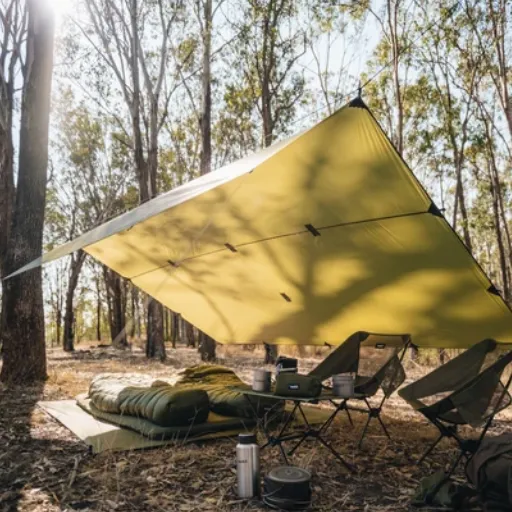
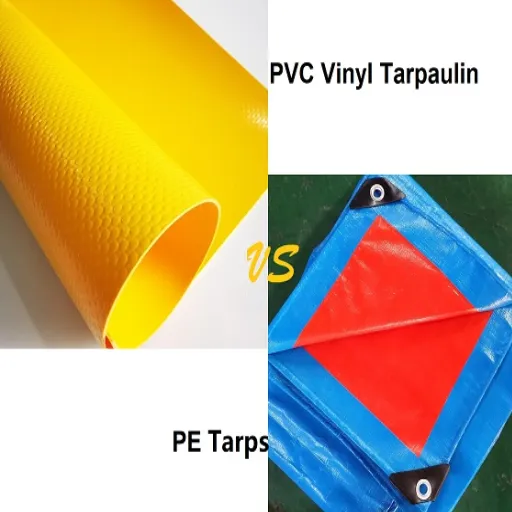
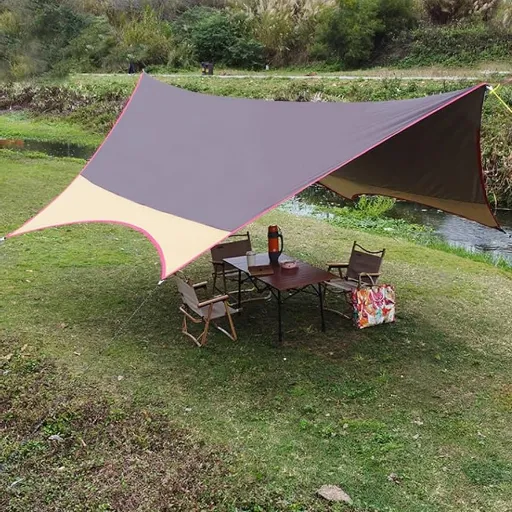
A heavy duty waterproof tarpaulin is a fabric covered in polyvinyl chloride or laminated with polyethylene with 600 GSM or higher, 5,000 mm or more in terms of hydrostatic head, with a tensile strength greater than 2,000 N per 5 cm strip. The material is designed to withstand constant exposure to the elements while also protecting loads such as truck covers, construction stockpiles or industrial enclosures that would destroy a normal 180 GSM tarp in a matter of months. And if you are in the market for one and want a legally binding quality description this is the buyer’s handbook.
The novel heavy-duty equipment in Ningbo was called to order by a procurement officer in the spring of last year by the name Chen who purchased 10 000 sq.m. of polyethylene cloth variously known as ‘heavy-duty waterproof tarpaulin’ from a new supplier claimed to be cheaper by 18 percent from the exoplanet of his trade. The order was placed with the supplier in China, but it did not state the weight of the tarpaulin because they widely referred to it as ‘Heavy-Duty Tarpaulin.’
This time it was a product of 350 gsm coated PE for waterproofing. Interlock was strong enough, so to say this was not the 900 GSM PVC he had been accustomed to for years. After 6 weeks, the covers on the trucks were torn in a downpour in Zhejiang. Total spending for shipping services and lost parcels added up to about ¥180,000.
The supplier pointed at the PO and said the product met spec. They were right. The fault was the spec. We’re here to help! Feel free to contact our team for more information or support.
Key Takeaways
- “Heavy duty” without a GSM number is a meaningless label. The industry working line is 600 GSM and up; serious applications start at 900 GSM.
- PVC laminated tarpaulin at 900 to 1,100 GSM delivers 5 to 10 years of service life; equivalent PE products typically last 1 to 3 years.
- Hydrostatic head, tensile strength, tear strength, and UV stability are the four numbers that decide field performance. Anything else is marketing.
- RF-welded seams, brass grommets every 50 cm, and a webbing-reinforced hem are non-negotiable for heavy-duty applications.
- A structured 8-point RFQ separates competent suppliers from order-takers. Vague specifications invite vague products.
What Counts as “Heavy Duty”?
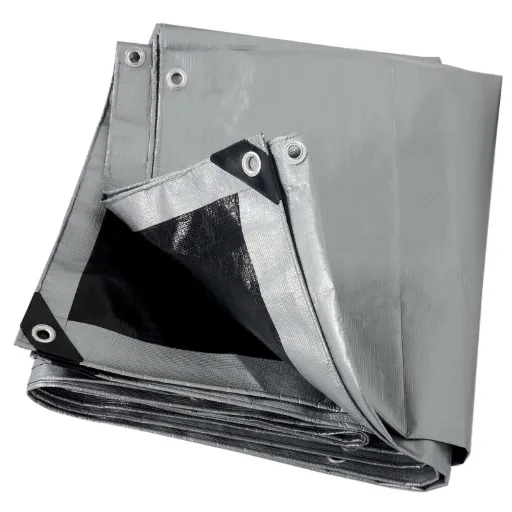
The term “heavy duty” carries no legal definition in the tarpaulin industry. Different suppliers draw the line at different weights, which is exactly why Mr. Chen got burned. There is, however, a working consensus among serious buyers and manufacturers.
A heavy duty waterproof tarpaulin meets all three of the following:
- Weight: 600 GSM or higher (most heavy-duty products run 750 to 1,100 GSM).
- Construction: coated PVC laminate or thick PE laminate, never single-layer woven.
- Performance floor: hydrostatic head of 5,000 mm or higher, tensile strength of 2,000 N per 5 cm strip or higher.
It’s worth separating two ideas that buyers often blur. “Heavy duty” describes the build (weight, reinforcement, seam type). “Waterproof” describes the barrier (hydrostatic head, seam sealing). A product can be one without the other. For the deeper read on what makes a fabric truly waterproof, including the ISO 811 hydrostatic head test method, see our pillar guide on what makes a tarpaulin truly waterproof.
GSM Tiers for Heavy Duty Waterproof Tarpaulin
GSM (grams per square metre) is the single most important number on the spec sheet. It correlates directly with material thickness, tensile strength, and field life. The trade-off is weight and shipping cost.
Use this tier table as a starting point when you scope your requirement:
| GSM Tier | Typical Material | Best Application | Service Life (Outdoor) |
|---|---|---|---|
| 600 GSM | Laminated PVC | General industrial covers, light truck covers | 3 to 5 years |
| 750 GSM | Laminated PVC | Construction stockpile covers, equipment shelters | 4 to 7 years |
| 900 GSM | Laminated PVC | Truck side curtains, multi-year construction enclosures | 5 to 8 years |
| 1,000 GSM | Coated PVC | Marine deck covers, building wraps under load | 6 to 10 years |
| 1,100 GSM | Coated PVC | Custom-print truck curtains, premium fleet specs | 7 to 10 years |
A fleet manager named Lin who worked for a logistics company in Ho Chi Minh City, Vietnam would change 200 GSM PE truck curtains every year. His schedule for replacing truck curtains changed after they started using 900 GSM PVC curtains with RF-welded seams in 2023 was 5 years instead of 12 months.
Nowadays, every individual truck curtain costs three times as much as it did before RF welding trenches was adopted. Lin’s annual budget for covers was cut by almost half. Traditional GSM-to-life calculations encourage cost-savings to a buyer.
Of course you do not have to use the thickest cloth for all operations. Over-spec increases material cost and freight expenses. Under-spec results in more replacements and fire loss. Additional strengthenings are not required; instead, it is required that the wind, UV exposure, and the length of the project are taken into account and tier allocation is developed to optimize the key area, the rest of the repeal being developed thereafter.
PVC vs. PE for Heavy Duty Use
Both materials can carry the “heavy duty” label, but they behave very differently in the field.
PVC laminated is the most frequently chosen material for critical commercial objectives. Indeed, a polyester mesh is sandwiched by two layers of plasticized PVC. As a result, the final product is a perineum that can be welded together with RF (so that no sutures are needed), can be printed in all the colors of the rainbow and would last 5 to 10 years under the weather. These are even more expensive per square meter, cannot be easily transported because they are heavier per roll, and presents a real challenge in terms of plasticiser limits for due compliance in the offshore market.
PE laminated means using a textile which consists of elements of woven HDPE tape to which is added on two sides – an LDPE film. It is light, cheaper for an area, may be recycled in the routine polyethylene avenues that may be available. However, the convenience offered is a trade-off: common current utilization would render it causable; exposure to external atmosphere can be 1 – 3 years and mechanical stitches show leakage at the needle holes due to the unsealed seams. Heavy PE is also produced but does not reach PVC 900 GSM for stress or tear properties such as 200-300 GSM tier.
The decision rule we give buyers in our sales inbox:
- Choose PVC when failure costs more than the tarpaulin: trucking fleets, multi-year construction enclosures, marine, branded customer-facing covers.
- Choose PE when the tarpaulin is consumable: single-season agriculture, packing protection, disaster relief, anywhere weight matters more than lifespan.
For comparison context across the cluster, see our heavy-duty tarpaulin range for material breakdowns and finished-goods specs.
Performance Specifications That Matter
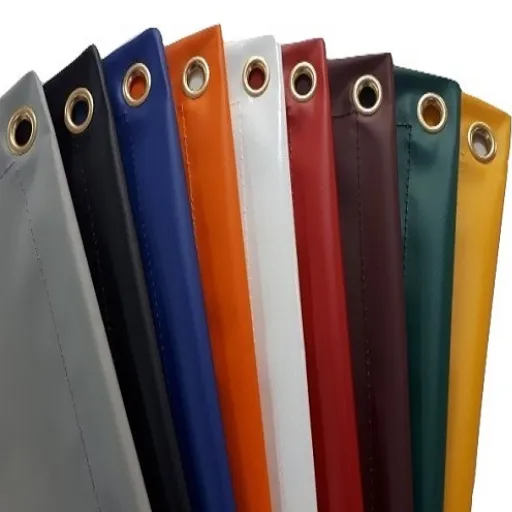
Four numbers, plus two certifications, describe whether a heavy duty waterproof tarpaulin will actually do its job. Ask for them on every quote.
Hydrostatic Head (mm water column)
The barrier rating, tested per ISO 811. Heavy-duty PVC at 900 GSM commonly tests at 8,000 to 12,000 mm. PE at 200 GSM typically tests at 2,000 to 3,000 mm. Anything below 1,500 mm is water-resistant, not waterproof.
Tensile Strength (N per 5 cm strip, warp and weft)
How much pull-load the fabric handles before it tears. Industry-standard for 900 GSM laminated PVC is roughly 2,500 N warp / 2,200 N weft. Lower is fine for sheltered applications; higher is needed for tensioned curtains and high-wind exposure.
Tear Strength (Trapezoidal method, ASTM D751)
How resistant the fabric is to a tear that has already started, measured per ASTM D751. This is what stops a small puncture from opening into a metre-long split when the wind hits. Specify it.
UV Stability (months to 50% tensile retention)
How long the fabric retains its strength under sun exposure. PVC with proper UV stabilisers holds up for 60+ months. Cheap PE without UV inhibitors can drop below 50% tensile retention in 12 to 18 months.
Cold Crack Resistance (-30°C minimum, where applicable)
If the tarpaulin will live anywhere with sub-zero winters, the PVC compound must resist cold-crack at the lowest expected temperature. This is a plasticiser-formulation question, and a competent supplier will name the test method.
Fire Retardancy (DIN 4102 B1, NFPA 701, where required)
Construction sites near hot work, event tents, and many industrial enclosures legally require certified fire-retardant fabric. If your end market needs it, list the certification by name on the RFQ, not “fire-resistant.”
Reinforcement, Hems & Grommets
Field failures rarely start in the middle of the panel. They start at the hem, the corners, and the tie-down points. A heavy duty waterproof tarpaulin must be reinforced where the load lives.
- Hem: folded once, ideally with webbing inserted for additional tensile capacity. A single-fold hem without webbing is an entry-level construction.
- Corners: triangular reinforcement patches, RF-welded or sewn-and-welded. The corner is where wind-loaded covers fail first.
- Grommet material: brass is the durable standard; aluminium is acceptable for indoor or low-load use; plastic is for consumer products only.
- Grommet pitch: 50 cm spacing for high-load applications (truck curtains, wind-exposed covers); 75 to 100 cm for general use.
- D-rings or quick-tension straps: optional for fleet specs and event tents; specify if you need them.
When you scope the spec, picture how the cover will be tied down. The number of tie-down points is the number of stress concentrators. More grommets means lower per-grommet load and longer service life. Skimping here is the cheapest way to lose the most expensive part of the cover.
How to Spec a Heavy Duty Waterproof Tarpaulin in Your RFQ
Vague RFQs invite vague products. Here’s the eight-point checklist we recommend buyers send to every supplier they’re evaluating, including us. A supplier who cannot answer all eight is not ready to take the order.
| # | Specification | Example |
|---|---|---|
| 1 | Material and GSM | “PVC laminated, 900 GSM, polyester 1000D scrim” |
| 2 | Dimensions and tolerance | “6 m × 12 m, ±2%” |
| 3 | Colour and print | “Pantone 354 C, single-side, 4-colour logo print” |
| 4 | Hem and reinforcement | “Folded hem with 30 mm webbing, triangular corner reinforcement” |
| 5 | Grommet material and pitch | “Brass #4, 50 cm pitch on all four edges” |
| 6 | Performance floors | “Hydrostatic head ≥ 8,000 mm, tensile ≥ 2,400 N/5cm warp” |
| 7 | Certifications | “REACH compliant, DIN 4102 B1 fire-retardant” |
| 8 | Packaging, MOQ, lead time | “Rolled, 50 pcs per pallet, MOQ 1,000 pcs, lead time 25 days” |
A buyer who sends this list signals competence. A supplier who confirms each line in writing is signalling capability. If a supplier reframes any line (“we don’t quote tensile, just trust the GSM”), that’s your cue to look elsewhere. Real numbers are not optional in industrial procurement.
Top Applications and Use Cases
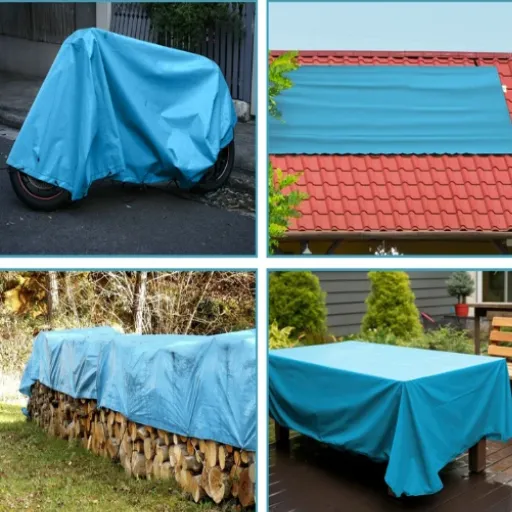
A heavy duty waterproof tarpaulin earns its premium price across a handful of demanding environments. Here’s where it pays off.
- Truck side curtains and roof covers: continuous flexing, UV, road grime. PVC at 900 to 1,100 GSM with RF-welded seams is the standard.
- Construction stockpile and enclosure covers: 750 to 900 GSM PVC, often fire-retardant, with reinforced hems for wind-load. See our tarpaulin solutions for construction sites.
- Industrial building wraps and equipment shelters: 900 GSM PVC, custom-printed for safety branding.
- Marine deck covers: 1,000 GSM marine-grade PVC, salt-resistant plasticisers, UV-stabilised for tropical service.
- Heavy agricultural covers: silage covers, large stack covers, livestock shelters. See our agricultural tarpaulin range for sizing and weight options.
- Custom-printed event tents: 650 to 900 GSM fire-retardant PVC, certified to NFPA 701 or DIN 4102.
For sizing options across these applications, our tarpaulin sheet guide covers standard widths, roll lengths, and joining methods.
Sourcing from a Manufacturer: What to Verify
The cheapest quote is rarely the cheapest tarpaulin. Before signing, verify the supplier with a short audit. We use the same checklist when we evaluate our own raw-material vendors.
- Test certificates: ask for current batch hydrostatic head, tensile, and tear reports. A reputable supplier produces these from their own lab and shares them on request.
- Compliance documents: REACH (EU), RoHS (electrical-adjacent products), Prop 65 (California). These take weeks to issue for a supplier who doesn’t already have them on file.
- Factory walk-through: video tour or in-person visit. We document our calendering line, lamination presses, and QC checkpoints; see our tarpaulin factory page for the production overview.
- MOQ and lead time: a clear, honest answer. Suppliers who quote “very fast” without a calendar-day number are guessing.
- Container loading economics: how many square metres fit in a 40′ HC, what packaging compresses the volume, and how that affects landed cost per square metre.
The point of this audit is not to catch lies. It is to filter out brokers and order-takers from actual manufacturers. The two read very differently when you ask them about plasticiser composition or weld parameters. We’re here to help! Feel free to contact our team for more information or support.
Total Cost of Ownership: A Worked Example
The cheap-tarpaulin trap is real, and the math is unforgiving. Compare two specs for a 100-square-metre truck cover requirement, evaluated over 7 years:
- The affordable selection will be the 200 GSM PE, 4persqm. Due to the UV as well as seam issues, this kind of material will have to be replaced every twelve months, and the total cost of material over 7 years would be; $100×7×4 = $2,800 taking into also account seven people who will work and the cost of not being able to use the structure within the timeframe of actual installation.
- In the heaviest details: 14 persqm. 900 GSM PVC was used to replace, at least, once within 7 year period. Within total 7 year lifespan, the material of total value $2,100 is due to be replaced once at a cost of tag of $1.5×100×14, with one labor switch and no breakdown or maintenance.
The heavy-duty option is 25% cheaper on material alone, before counting labour, freight, and the cost of cargo damage during failure events. Cheap tarpaulins are expensive when measured per year of service. The label on the invoice is not the price; the price is the per-year cost over the full service life.
If you have any questions or need further assistance, don’t hesitate to get in touch with us.
Frequently Asked Questions
What GSM is considered heavy duty?
The industry working line is 600 GSM and up. Serious commercial applications (truck curtains, multi-year enclosures, marine) start at 900 GSM. Anything below 450 GSM is medium-duty at best, regardless of label.
Is a heavy duty tarpaulin always waterproof?
No. “Heavy duty” describes the build, not the barrier. Some heavy canvas tarpaulins are breathable and water-resistant, not fully waterproof. Always confirm the hydrostatic head rating in the spec sheet.
How long does a heavy duty waterproof tarpaulin last?
PVC at 900 GSM or above typically delivers 5 to 10 years outdoors with proper care. PE at 250 to 300 GSM gives 1 to 3 years. Service life depends on UV exposure, handling, and storage practices as much as on the material itself.
Can you customise the size, colour, and grommets?
Yes. We produce custom dimensions, colours, branded printing, grommet patterns, and corner reinforcement on order. MOQs and lead times vary with specification. Standard PVC orders ship in 25 to 30 days; custom-printed in 35 to 45 days.
What certifications should I require for export markets?
The common list: REACH (EU plasticiser compliance), RoHS (electrical-adjacent products), DIN 4102 B1 or NFPA 701 (fire retardancy where required), Prop 65 (California). Specify by name and number on the PO; ask for the certificate before shipment.
What’s the typical MOQ and lead time?
For standard heavy-duty PVC, MOQ is usually 500 to 1,000 pieces or one 20′ container, lead time 25 to 30 days. Branded printing or specialty certifications add 5 to 10 days. Container loading and ocean freight add 30 to 45 days for most destinations.
Conclusion: Buy the Spec, Not the Label
Mr. Chen’s ¥180,000 lesson is preventable, and you don’t need to learn it the same way. The three buying principles that separate good outcomes from expensive ones:
- Specify the GSM, never accept “heavy-duty” as a standalone descriptor.
- Demand the four performance numbers: hydrostatic head, tensile, tear, and UV stability. With those four, you can compare any two suppliers honestly.
- Verify the construction: RF-welded seams, brass grommets at 50 cm pitch, webbing-reinforced hem.
When you’re ready to spec a heavy duty waterproof tarpaulin for your next project, whether a single fleet retrofit or a 40-foot container of construction covers, we’re here to help you build the right specification, not just sell the cheapest roll. Browse our full tarpaulin guide and product range, or send us your eight-point RFQ and we’ll respond within 24 hours.