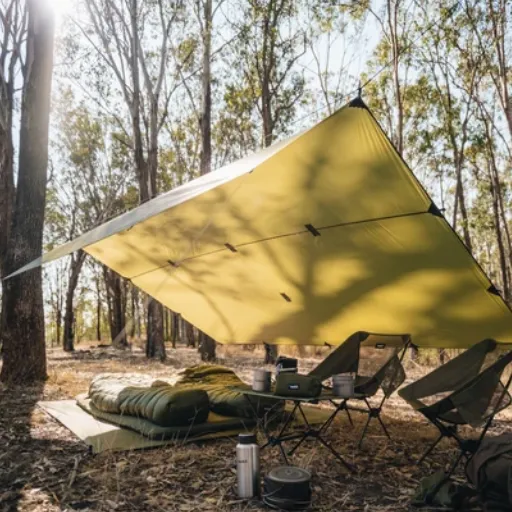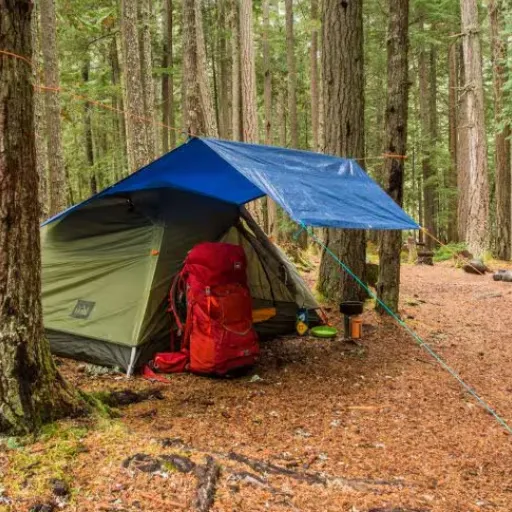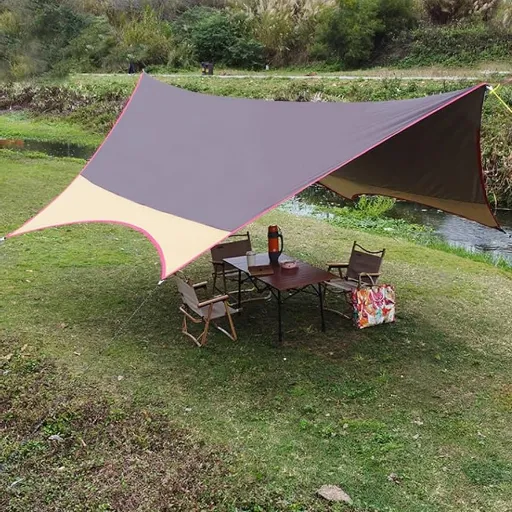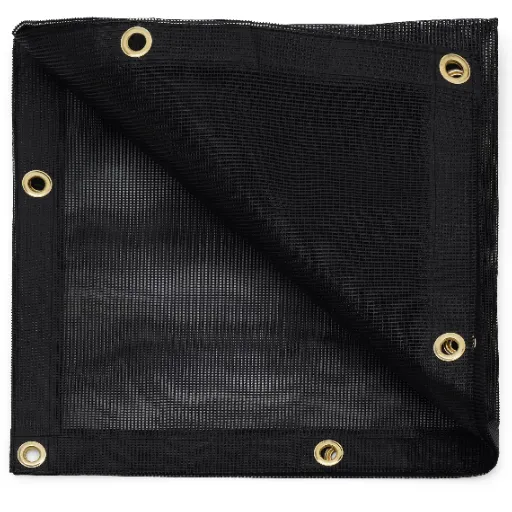
The best tarp for hammock camping is one whose ridgeline runs 1 to 2 feet longer than your hammock. For a standard 11 ft hammock, that means a 12 x 10 ft tarp in a waterproof material matched to how you actually camp. Backpackers want silpoly. Car campers, families, and groups get equal protection from a reinforced polyethylene tarpaulin at a fraction of the price.
Ask a hammock camper what ruined their last trip and the answer is almost never the hammock. It is the tarp. Too short, pitched too flat, or bought for a backpacking trip they were never going to take.
You already know the hammock is the comfortable part. This guide covers the coverage math, the five tarp materials worth considering, how a cheap poly tarp compares to a $300 cottage rain fly, and the setup mistakes that soak campers even under good gear.
We build tarpaulins for camps, farms, and construction sites, so we have no incentive to push the most expensive option. Sometimes the honest answer is a basic reinforced tarp. You can browse our full tarpaulin guide if you would rather start from specifications.
Key Takeaways
- Size so the ridgeline is 1 to 2 ft longer than your hammock. An 11 ft hammock needs a 12 ft ridgeline, which means a 12 x 10 ft tarp.
- A plain polyethylene tarp works well for car camping, basecamp, and group trips. It is heavy and bulky, so it is a poor choice for backpacking.
- Grommet tear-out is the most common failure on budget tarps. Reinforced corners and edges solve it, so look for those before you compare price.
- Cut size is not finished size. An 8 x 10 tarp finishes near 7 ft 6 in x 9 ft 6 in, so buy a size up when dimensions are critical.
- Water pooling and condensation are setup problems, not material problems. A taut ridgeline, a 25 to 30 degree pitch, and ventilation prevent both.
Do You Really Need a Tarp for Hammock Camping?
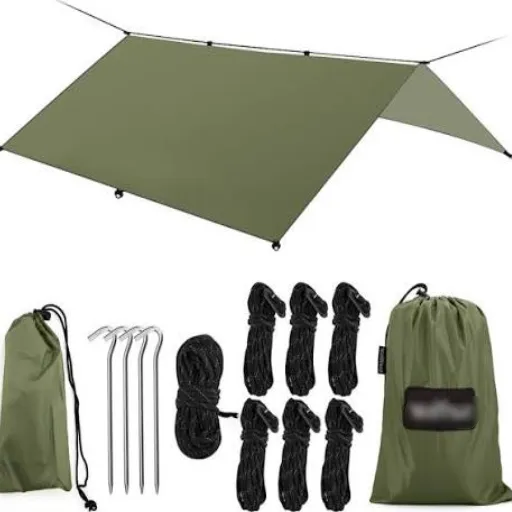
Yes. A tarp protects a hammock from rain, wind, dew, and falling debris. Even in summer, overnight dew soaks an unprotected quilt, and a hammock loses heat fast when wind moves underneath it.
A bug net keeps insects out. A tarp keeps weather out. They are not substitutes, and most experienced hangers carry both.
The only time you can safely skip one is a short fair-weather trip with no meaningful dew and a sheltered site. That is a narrow set of conditions, so if you are new to hammock camping, bring the tarp anyway. Contact Linyi Chenlai Plastic Products Co., Ltd. for reliable waterproof tarp solutions tailored to your needs.
What Size Tarp Do You Need for Hammock Camping?
Size your tarp so the ridgeline is 1 to 2 feet longer than your hammock, leaving 6 to 12 inches of overhang past each end for light rain and 18 to 24 inches for storm protection. Width matters just as much, because it sets your side coverage when rain blows in sideways.
Priya bought an 8 x 8 tarp for her first hammock trip, reasoning that a hammock is only about 6 ft wide. It rained for three hours. The tarp covered the middle of her hammock and nothing else, and by 2 a.m. both ends of her quilt were soaked. It was not defective, just four feet too short.
The Overhang Rule and the 83% Ridgeline Math
Two numbers explain almost every sizing decision.
The first is the overhang rule. Your tarp should extend 1 to 2 feet past each end of the hammock. Without that margin, water runs down the suspension straps and into the hammock body.
The second is the 83% rule. A gathered-end hammock sags when you lie in it, so a 12 ft hammock has a working ridgeline closer to 10 ft. Multiply your hammock length by 0.83 to get the span you actually need to cover.
Put them together. An 11 ft hammock has about a 9 ft working ridgeline, so a 12 ft tarp gives you roughly 18 inches of overhang per side. That is comfortable three-season coverage without dragging excess fabric through the trees.
Hammock Tarp Size Chart by Hammock Length
This size chart is the fastest way to pick a number. Find your hammock length and read across.
| Hammock Length | Minimum Tarp Ridgeline | Recommended Tarp Size | Best For |
|---|---|---|---|
| 9 ft | 10 ft | 11 x 9 ft | Solo, ultralight, summer |
| 10 ft | 11 ft | 11 x 10 ft or 12 x 10 ft | Solo, three-season |
| 11 ft | 12 ft | 12 x 10 ft | Solo or pair, most conditions |
| 12 ft | 13 ft | 13 x 11 ft or larger | Larger hangers, winter |
| 13 ft and up | 14 ft | 14 x 12 ft or larger | Two-person, bridge hammocks |
If you camp cold or expect storms, take the next size up: a steeper pitch pulls the tarp inward and costs 18 to 24 inches of effective width.
Our standard tarpaulin sheet sizes include the 8 x 10, 10 x 12, and 12 x 16 formats that cover most hammock setups, and we cut custom dimensions when a standard size will not do.
Cut Size vs Finished Size
Here is a detail that surprises almost every buyer of an inexpensive tarp: the size on the label is the size before hemming. An 8 x 10 ft cut-size tarp finishes around 7 ft 6 in x 9 ft 6 in once the edges are folded and stitched.
On a large tarp that lost half foot matters little. On a compact tarp where you calculated a tight overhang, it is the difference between dry and wet. Order one size above your calculated minimum, or confirm the finished dimensions with the supplier first.
Diamond vs Rectangle
A rectangle gives you the most coverage and pitching options. A diamond, a square pitched on its corner, yields a longer ridgeline from the same fabric: a 10 x 10 ft square pitched as a diamond gives roughly 14 ft of ridgeline.
The trade-off is side coverage. A diamond leaves your ends exposed and handles high wind poorly. Rectangles with end doors handle storms far better, and hex tarps sit in between. Ultralight backpackers accept the diamond compromise for weight; everyone else is usually happier with a rectangle or hex. Discuss your waterproof tarp requirements with Linyi Chenlai Plastic Products Co., Ltd. for customized options.
Hammock Tarp Materials Compared: PE, PVC, Silnylon, Silpoly, and DCF
Five materials cover almost every tarp sold for hammock camping, and they sit at very different points on the weight, durability, and cost spectrum.
| Material | Weight (12 x 10) | Waterproofing | Pack Size | Durability | Cost | Best For |
|---|---|---|---|---|---|---|
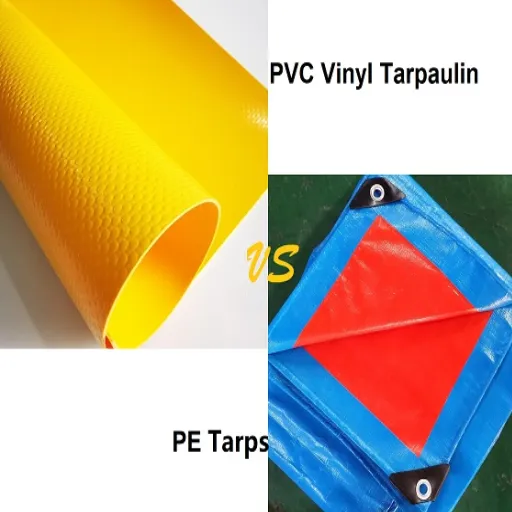
| PE | 3 to 5 lb | 1,000 to 2,000 mm | Bulky | 3 to 5 yr | 10to25 | Car camping, groups |
| PVC-coated | 6 to 12 lb | 3,000 mm+ | Very bulky | 8 to 12 yr | 40to150 | Fixed shelters |
| Silnylon | 1.5 to 2.5 lb | 2,000 to 3,000 mm | Compact | 5 to 8 yr | 60to150 | Backpacking |
| Silpoly | 1.5 to 2.5 lb | 2,000 to 3,000 mm | Compact | 6 to 9 yr | 70to160 | Backpacking, all-season |
| DCF | 0.7 to 1.2 lb | 5,000 mm+ | Very compact | 4 to 7 yr | 250to450 | Long-distance hiking |
PE and PVC Tarps
Polyethylene tarps are woven fabric laminated with a PE coating. They are cheap, waterproof, and strong against tearing, but not light. A 12 x 10 PE tarp runs 3 to 5 lb, heavy for a pack and irrelevant in a car. UV resistance is lower than coated nylon, and the cheapest versions use grommets that pull out under wind load.
PVC-coated tarpaulins are the durable end of the spectrum. Hydrostatic head ratings usually reach 3,000 mm and above, and a good PVC tarp outlasts several nylon ones in repeated use. The cost is weight, often 6 to 12 lb, and PVC does not compress.
Silnylon, Silpoly, and DCF
Silicone-coated nylon and polyester dominate the backpacking market. Both are light, compact, and strong. Nylon stretches when wet, so a silnylon rain fly sags overnight and needs re-tensioning. Silpoly stretches far less, resists UV better, and runs quieter in wind, which makes it the better buy today at a similar price. Nylon still keeps an edge in tear strength.
DCF, a laminate of Dyneema fibers, is the lightest and most waterproof option and does not stretch at all. It is also the most expensive by a wide margin and not the most abrasion-resistant. A DCF tarp costs 250to450 and is built for carrying shelter over hundreds of miles.
What Is Hydrostatic Head?
Hydrostatic head is a measure of how much water pressure a fabric resists before it leaks, expressed in millimeters. A 1,000 mm rating resists light rain. 2,000 to 3,000 mm handles steady rain and some wind-driven spray. 5,000 mm and above is storm-grade.
A practical floor for hammock camping is 1,500 mm, and 3,000 mm is comfortable. PU-coated hammock tarps are commonly rated at 3,000 mm, with premium rain flies reaching 5,000 mm. Our waterproof tarpaulin range lists hydrostatic head ratings on every product, so you can compare on the number that matters rather than on marketing language.
A high hydrostatic head does not stop condensation, which is a separate problem covered below.
Can You Use a Regular Tarp for Hammock Camping?
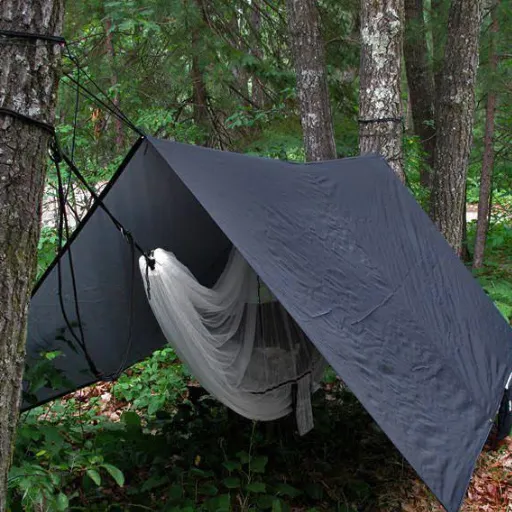
Yes, and it works better than the ultralight community usually admits. A 10 x 12 ft polyethylene tarp has enough coverage for a hammock and will keep you dry in serious weather if you pitch it correctly. Cheap tarps fail at the grommets long before they fail anywhere else.
Marcus ran a summer outdoor program for a regional youth organization and needed shelter for 40 hammocks. Purpose-built hammock tarps at $120 each would have consumed three seasons of equipment budget. He bought reinforced 10 x 12 polyethylene tarps instead, ordered in bulk with stenciled program branding. Five seasons later, 34 of the original 40 are still in service.
Poly tarps make sense whenever the tarp stays near a vehicle, gets shared between users, or needs to survive being folded by a teenager at 6 a.m. That is most hammock camping that is not a thru-hike.
The Grommet Problem, and How Reinforced Edges Solve It
Ask any hammock forum what goes wrong with a cheap tarp and you will get one answer: the grommets tear out. Wind loads a corner, the grommet pulls through, and your shelter develops a hole exactly where it needs strength.
This is a manufacturing problem, not a materials problem, and it is fixable. Reinforced corners add a second layer of fabric at each tie-out point, and reinforced edges stop tears from propagating. When you buy a poly tarp, look for those two features before you look at anything else. A slightly dearer tarp with reinforced corners will outlast three cheap ones, which is why our heavy-duty tarpaulin range uses them as standard.
Weight, Bulk, and Noise: The Honest Trade-Off
A poly tarp is a poor backpacking choice. Three to five pounds is a real burden, PE fabric does not compress, and it is loud in wind.
If you are hiking any distance, buy silpoly. If your tarp travels in a vehicle, poly is the sensible purchase. Our tarpaulin roll options list fabric weights per format if you want to compare.
How to Hang a Tarp Over a Hammock
Hanging a tarp correctly comes down to three things: a separate ridgeline, a steep pitch, and consistent tension.
Step-by-Step Setup
- Choose two trees 12 to 15 ft apart with clear ground beneath, and check for dead branches overhead.
- Hang the hammock first at a 30 degree suspension angle so you can see the space you need to cover.
- Run a separate ridgeline above the hammock using low-stretch cord. Paracord stretches when wet.
- Attach the tarp with Prusik knots or small carabiners so you can slide it along and center it.
- Set the ridgeline 18 inches above the hammock so condensation cannot drip onto you.
- Stake the corners 3 to 4 ft out at roughly 45 degrees, with guy lines in a V shape away from the shelter.
- Tension in a cross pattern, alternating opposing corners, so the tarp pulls evenly.
- Aim for a 25 to 30 degree sidewall pitch. Flat pitches pool water; steep pitches shed it.
- Add drip lines below the tarp so water cannot run down the suspension.
- Check the gap. If the fabric touches the hammock, water wicks along the contact point.
The pitch you choose then depends on conditions. A-frame and diamond suit fair weather, porch mode gives you a covered view, and storm mode with both sides staked down handles wind-driven rain. DutchWare’s taxonomy of tarp shapes covers the asymmetrical and wide variants.
How High Should the Tarp Sit Above the Hammock?
About 18 inches above the hammock is the sweet spot. That gap keeps the tarp clear of your body, avoids condensation dripping onto you, and still allows airflow. When weather turns serious, drop the tarp to roughly 8 inches and stake the windward side toward the ground. You lose ventilation and gain storm protection, so open the leeward end slightly to compensate.
Water Pooling, Condensation, and Weather-Specific Setup
Almost every “my tarp failed” story comes down to one of two issues, and neither is caused by a tarp being cheap.
Why Water Pools on the Ridgeline
Water collects wherever a tarp has a flat section. A sagging ridgeline creates a basin, the basin fills, and the weight can pull the whole shelter down.
The fix is tension. Keep the ridgeline taut so water runs along it and sheds off the staked sides, as The Ultimate Hang notes. Fabric stretches overnight as it absorbs moisture, so re-tension the guy lines before you sleep and once more through a long storm. Line tensioners let you do that without retying knots in the dark.
Condensation Is Physics, Not a Leak
If you wake to a wet inner surface, your tarp is probably not leaking. You are seeing condensation, and it happens with every coated fabric, including expensive ones.
Your breath adds moisture to the air inside the shelter, which is warmer than the outside air. When it touches the cold underside of the tarp it condenses, like a cold glass on a warm day. Calm, humid, cold nights make it worse. Since you cannot seal your way out of it, manage it. Ventilation is the primary tool, so avoid sealing every side. A steep pitch lets moisture run to the edges rather than dripping, and keeping the tarp clear of your quilt keeps the condensation on the fabric instead of on you.
Summer, Storm, and Winter Adjustments
Summer: pitch high and open, using a diamond or an A-frame with one side raised. Bring the tarp anyway, because summer dew soaks an unprotected quilt and afternoon storms arrive without warning.
Steady rain and wind: pitch low and steep with the narrow end facing the prevailing wind. Angle the windward side toward the ground and keep the leeward side slightly open. Re-check tension after the first hour of rain, when the fabric has stretched.
Winter and below-freezing: a rectangle with end doors is the right tool. Close the doors to block wind and pitch lower and steeper than in summer. Ventilation is now safety, not comfort, because a wet quilt in freezing conditions is dangerous. Leave a small gap at the highest point and accept a little heat loss. If you camp cold regularly, look for a hammock tarp with doors and enough tie-out points.
Making Your Tarp Last: Care, Repairs, and Group Procurement
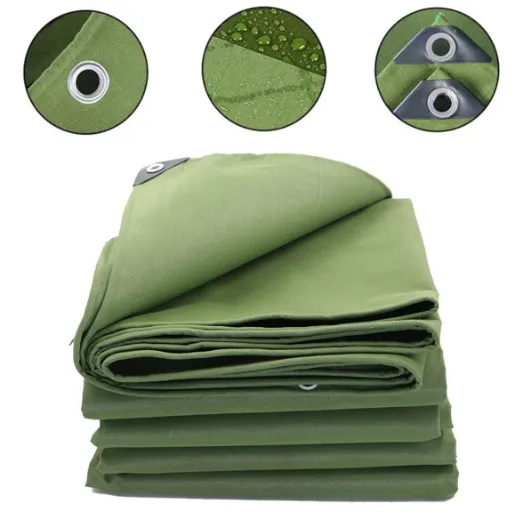
Never store a tarp wet. Mildew destroys coated fabric and the damage is permanent. Rinse with plain water and mild soap, avoid solvents that attack coatings, and dry the tarp fully before storage. For repairs, tarp tape handles pinholes, and wrapping a small stone in the fabric and tying off will hold a torn corner through bad weather.
If you are equipping a group, standard retail tarps create a maintenance problem. Sizes vary, replacements do not match, and nobody can tell which tarp belongs to which shelter. Custom manufacturing solves that: specify the size once, order the same specification every time, and add color coding so equipment is easy to track. Reinforced corners matter more in group use than anywhere else, because you cannot rely on every user to pitch shared gear gently.
We manufacture for camps, youth programs, and rental fleets, and supply custom dimensions, attachment points, and branding from our own tarpaulin factory.
Frequently Asked Questions About Tarps for Hammock Camping
What size tarp do I need for hammock camping?
Your tarp’s ridgeline should be 1 to 2 feet longer than your hammock. For an 11 ft hammock, choose a 12 ft ridgeline, which means a 12 x 10 ft tarp. That leaves 6 to 12 inches of overhang per end for light rain, or 18 to 24 inches for storm protection.
Can I use a regular poly tarp as a hammock rain fly?
Yes. A 10 x 12 ft polyethylene tarp covers a standard hammock and stays waterproof in heavy rain. Choose one with reinforced corners, because grommet tear-out is the most common failure point. It suits car camping, not backpacking, where weight and bulk become a real burden.
What is the best material for a hammock tarp?
It depends on how you camp. Silpoly is the best all-round backpacking choice: light, compact, and stretches less than silnylon when wet. For car camping, basecamp, and group use, a reinforced polyethylene or PVC tarpaulin gives more durability per dollar.
How do you stop condensation under a hammock tarp?
Ventilation, not more waterproofing. Condensation forms when your breath adds moisture to warmer air that then touches the cold underside of the tarp. Leave one side partly open, pitch steeply so moisture runs to the edges, and keep the tarp from touching your quilt.
The Right Tarp for Hammock Camping Is the One That Matches Your Trip
The tarp decides your comfort far more than the hammock does, and getting the tarp for hammock camping right is about matching material to use rather than spending more.
Size for a ridgeline 1 to 2 feet longer than your hammock. Choose silpoly if you backpack, a reinforced polyethylene or PVC tarpaulin if you camp near a vehicle or equip a group. Look for reinforced corners before you compare prices, then pitch steep, keep the ridgeline taut, and leave room for ventilation. Do that and you will stay dry with a 20tarpora400 one.
If you are choosing a tarpaulin for a hammock setup, a camp, or an outdoor program, send us your hammock dimensions and conditions and our team will recommend the format, coating weight, and attachment points that fit.