Last updated:
A custom size tarpaulin order needs more than a length and width. The buyer, supplier and receiving team must agree what those numbers measure. A label might describe raw cut fabric, a finished sheet or the object underneath. Each size answers a different question.
Start with the area you need to cover. Then agree the finished size, its limits and how to check it. This guide provides a worked side-drop calculation, a tolerance example and a worksheet you can use before confirming an order. The example sizes are assumed inputs. They are not Chenlai production limits or a fit guarantee.
Custom size tarpaulin: define the finished dimensions
A custom size tarpaulin is a cover made to the size and details stated in an order. Name the finished edges you want checked and state the allowed range. Keep the object size, cover size and raw fabric allowance separate in the quote.
A size label is not an acceptance limit
Use these four terms on your sketch. Each term has its own role.
| Measurement | What it describes | What the buyer should record |
|---|---|---|
| Object size | Equipment, load or opening being covered | Measured spans, protrusions and reference points |
| Required coverage | Path the cover must span, including specified drops | Top path, each drop and any fastening extension |
| Finished size | Completed cover after fabrication | Named edges, dimensions and acceptable limits |
| Cut size | Fabric dimensions before the specified finishing work | Supplier-confirmed basis and fabrication allowance |
Supplier conventions differ. For example, Tarpaulin Supplies UK’s size guide explains the distinction between cut and finished sizing. Treat its product conventions as its own. Ask what the size on your quote means. Don’t assume every supplier uses the same label.
Illustrative scenario: Two quotations both say “6 m cover.” One refers to cut fabric; the other refers to the completed sheet.
Comparing their prices before clarifying that difference means the buyer is pricing two different items. Request finished edge dimensions and limits on both quotations before choosing.
For your custom size tarpaulin, write “finished edge to finished edge” where that is the intended basis. Add a separate note for any opening or fixing position that governs fit. A finished-size label alone won’t define these details or promise an exact fit.
Roll width is another measurement again. If you buy fabric for later conversion, use the separate roll dimensions and ordering checks. Don’t treat a roll-width description as proof of the size of a fabricated sheet.
Measure a custom size tarpaulin for the coverage you need
Measure the path the cover will follow, then identify where each edge must end. For a custom size tarpaulin, the widest footprint alone may omit side drops, a raised top or clearance around a protrusion. Record those features before deciding the final drawing dimensions.
Flat rectangles
To size a custom size tarpaulin for a flat opening, name its reference corners and measure its length and width. Check more than one position where the edges vary. Mark the widest span and any local projection rather than reducing an irregular opening to one convenient reading.
Record diagonals if you need to check how the corners line up. Matching length and width does not, by itself, establish that every corner lies where the drawing requires. If the shape is not a rectangle, sketch its outline and label each edge.
Keep a measurement sheet for each different equipment model or opening. Similar-looking units may have different brackets, handles or anchor locations. For a fleet order, state which cover goes with which unit. A photo of one unit can’t define the size of all the others.
Loads with side drops
For a custom size tarpaulin over a simple rectangular load, separate the top span from the drop on each side. The following custom size tarpaulin calculation assumes a flat top, vertical sides and no extra extension:
Coverage width = top width + left drop + right drop.
If the top width is 2400 mm and each required side drop is 600 mm, the coverage width is:
2400 + 600 + 600 = 3600 mm.
That result describes the assumed coverage path. It does not include an extra fastening extension, and it does not calculate the fabric consumed by a hem. Apply the same reasoning to the length direction using its own measured top span and end drops.
Returning to the illustrative scenario, a buyer who sends only the 2400 mm footprint has omitted 1200 mm of intended side coverage.
The correction is to draw and label the drops. Adding an unexplained percentage would leave the supplier guessing which edges need the extra material.
If one side needs a longer drop, record it separately. Write the required edge destination on the sketch, such as a marked line below the top surface. Keep access openings and any area that must remain exposed visible on the drawing.
Peaked or irregular geometry
A peaked shape needs the actual surface path rather than its horizontal projection. Curved surfaces, stepped equipment and off-center fittings also need their own dimensions. Don’t stretch the rectangular calculation into a roof or load design rule.
MyTarp’s drawing guidance distinguishes a drawing of the tarp from a picture of the object. Use photographs to explain context, then transfer the required cover outline and dimensions to a drawing. Mark which face the drawing shows so left and right stay clear.
Before confirming your custom size tarpaulin, send Chenlai the measured dimensions, intended use and sketch to discuss the requirement. Use an approved dimensioned drawing to carry the agreed geometry into the order.
Separate hems, seams and fixing positions from coverage
A custom size tarpaulin can meet its outer dimensions while its fixing centers miss the intended anchors. Coverage, fabrication and hardware therefore need separate drawing notes. Adding material to one dimension does not automatically correct a different feature.
Finished edges versus raw-cut allowance
Hems and seams consume fabric according to the chosen construction. Tarpaflex’s FAQ explains why cut size and finished size differ. Its examples do not establish a universal allowance for every material or supplier.
If you specify finished dimensions, ask the supplier to confirm the fabrication layout needed to achieve them. Don’t add a second hemming allowance to the finished-size request unless both parties have explicitly agreed that calculation. Otherwise, the quotation may include an extension you never intended.
For a custom size tarpaulin with a pocket, give its clear inside width as well as the outer sheet size. Show where a sleeve starts and ends. If a seam must avoid an access opening or a defined contact area, mark that restriction separately.
Edge lengths versus hardware centers
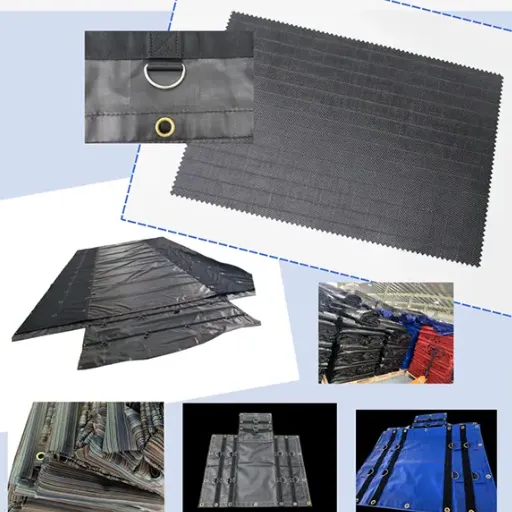
Choose a datum: a named reference edge or point from which a dimension starts. Label it on the drawing, then show fixing-center distances from that reference. State whether a dimension runs to the finished edge, hole center or another named feature.
Don’t write only “even spacing” when the cover must match existing anchors. Record the required center positions and identify any corner exceptions. For the hardware details, use the separate guide to grommet layout and reinforcement.
The DERFLEX tolerance guide also separates overall dimensions from hardware positions and measurement conditions. That distinction is useful for a custom size tarpaulin drawing: an acceptable outer width does not prove an acceptable center offset.
Check which face the drawing shows before approving an asymmetric layout. A mirrored drawing can preserve the same outer dimensions while putting a cutout on the wrong side. Dimension notes communicate geometry; they don’t establish fastening strength, wind resistance or installation safety.

Agree custom size tarpaulin tolerances before ordering
Finished size describes the fabrication stage at which a dimension applies. Tolerance describes the permitted variation. Your custom size tarpaulin order needs both, along with a method for checking the result. Ask for written confirmation of achievable limits before treating a requested range as an agreed specification.
Nominal dimensions and lower and upper limits
The nominal dimension is the target size. The lower limit is the least allowed value; the upper limit is the most allowed value. Write all three where a receiving inspector needs an unambiguous comparison.
Illustrative scenario: A drawing states 6000 mm ±20 mm. Its lower limit is 5980 mm and its upper limit is 6020 mm. A sheet measuring 5990 mm lies inside that example interval. Yet it would still be shorter than a separate functional requirement of at least 6000 mm.
The buyer must settle that gap before placing the order. If 6000 mm is the minimum needed, state that requirement and discuss suitable limits with the supplier. Don’t assume that a symmetric tolerance around the minimum protects the intended fit.
For a custom size tarpaulin, turn a percentage tolerance into its lower and upper limits. In another illustrative calculation, 1% of 6000 mm is 60 mm. A specification of 6000 mm ±1% therefore spans 5940 mm to 6060 mm. This shows how the range grows with size. It does not propose a 1% production tolerance.
Avoid copying a tolerance from another supplier’s product page. Its fabric, seams, size basis and checking method may differ. The relevant agreement is the one confirmed for your drawing and order.
Agree the measurement condition
State how the custom size tarpaulin will be supported and measured. Identify whether it should lie flat and relaxed or be checked in another agreed state. Define any applied tension rather than leaving each inspector to pull until the sheet “looks right.”
Write the checking method in short notes:
- Name the start and end points for each reading.
- State the tape or other tool and the unit to use.
- State how the sheet rests and whether any pull is applied.
- Include any conditioning or temperature limits required by the chosen method.
- Agree how to handle folds and an uneven surface before taking readings.
Overall length, width, diagonals and fixing positions need their own controls where they affect fit. A length reading can’t replace a diagonal check. Nor should a hardware-center measurement be judged against an overall-edge tolerance without a written basis.
For your custom size tarpaulin inquiry, give Chenlai these fit needs:
- The least usable length or width the cover must provide.
- The most space it can take up where excess size would cause a problem.
- The edge, opening or fixing point that controls each need.
- The proposed range and method for checking each feature.
Ask for written confirmation of what can be made and checked. Resolve a gap between the proposed range and your fit needs before you approve the order.
Record the size specification and check the delivered cover
Another inspector should be able to repeat the measurement from your record. Keep the approved drawing, order confirmation and receiving readings together. At delivery, those documents must name the same custom size tarpaulin, sizes and drawing version.
Dimension worksheet
Use a separate row for each controlled feature. The entries below are suggested record fields, not a mandatory sampling plan or a statement of Chenlai production capability.
| Field | What to enter |
|---|---|
| Reference and revision | Order, drawing number, revision and item identifier |
| Material identification | Agreed material or product reference linked to that drawing |
| Governing unit | One controlling unit; secondary conversions marked as reference |
| Feature and datums | Named edge, diagonal, opening or fixing-center position |
| Nominal and limits | Target, lower limit and upper limit for that feature |
| Measurement state | Agreed support, relaxation or tension and relevant conditions |
| Instrument | Tape or other agreed instrument identification |
| Readings and record | Actual value, observer, date and supporting photograph reference |
Use consistent units throughout a custom size tarpaulin worksheet. NIST’s length-unit reference gives 1 inch as exactly 25.4 mm and 1 foot as exactly 0.3048 m. Label rounded secondary values as reference so they do not create conflicting acceptance limits.

Receiving measurement record
Unpack and identify the sheet, then follow the agreed measurement state and datums. Record the actual reading before writing a pass or discrepancy note.
Keep photographs that show the feature, measurement endpoints and instrument reading; a close-up number alone omits its context.
Illustrative scenario: One inspector pulls a flexible sheet taut while another measures it relaxed. Their readings differ. Before judging the custom size tarpaulin against the order, check which state was agreed and repeat the measurement on that basis. Preserve both original observations and the repeat result.
For a custom size tarpaulin, this example shows how one row could read. The values are assumed for this guide, not a recommended size or tolerance:
| Record item | Illustrative entry |
|---|---|
| Drawing and feature | Sketch A, revision B; long edge L1 |
| Reference points | Finished corner A to finished corner B |
| Agreed range | 5980 mm to 6020 mm |
| State | Flat and relaxed on the agreed support |
| First reading | 5990 mm |
| Repeat reading | 5992 mm, taken at the same endpoints |
| Comparison | Both readings lie within this example range |
| Record notes | Add sheet ID, tape ID, observer, date and photo reference |
The two readings above do not create a rule to measure every feature twice. They show why the record needs both the value and the method.
If the repeat reading falls outside the agreed range, keep it and report the difference. Don’t choose only the value that passes or use an average to hide it. Ask the named decision maker how to proceed under the agreed checking plan.
Compare each named feature with its own limits. If a reading is unclear or outside the range, identify the affected sheet and feature for an authorized decision. Don’t alter the original drawing or average unlike dimensions to remove a discrepancy.
Use the tarpaulin incoming inspection checklist for the wider receiving and release process. This dimensional record does not decide how many sheets to sample or whether a whole lot may be released.
The ISO 2286-1 catalog describes measurements of roll length, width and net mass for coated fabrics. That scope does not supply a universal finished-sheet tolerance. Agree the method and limits for the actual finished cover rather than adding an unexplained standard reference.
Custom size tarpaulin order checklist and buyer questions
Before comparing offers, check that each custom size tarpaulin quotation describes the same finished geometry. If the size bases differ, the quotes may buy different covers. Use the separate guide to comparing custom tarpaulin quotes after the dimensional requirement is clear.
Is finished size exact?
“Finished” identifies the completed cover rather than the raw cut fabric. It doesn’t state zero variation. For a custom size tarpaulin, specify the acceptable limits and the checking condition alongside the finished dimension. A size written to the nearest millimeter still needs that agreement.
How much extra should I add?
Calculate the coverage path and specified drops first. Add only the fastening extension or other allowance the application actually requires. Keep the supplier’s fabrication allowance separate. There is no single extra margin in this guide that suits every shape, hem or fixing arrangement.
Can I size a cover from a photograph?
A photo can show the use, things in the way and which face you mean. It can’t give every size. Provide a measured drawing of the custom size tarpaulin outline, including openings and reference points. Mark any size that you still need to check before placing the order.
What if length passes but the anchors miss?
Check the separately specified fixing-center positions, offsets and orientation.
A length check can pass while a fixing point is in the wrong place. Log both results against the right features on the drawing. Ask the person in charge of acceptance to decide what to do.
Which unit governs, and must I accept an undersized cover?
Use the unit named as governing in the agreed order; resolve contradictory converted values before approval.
A cover within a written range can still reveal a wrongly specified functional minimum. Log the issue and ask the person in charge for a decision. Keep the limits that were agreed before delivery.
Before releasing the specification, confirm:
- The cover outline, viewing direction and drawing revision are clear.
- Finished dimensions include the required coverage and drops.
- Each fit-sensitive feature has named datums and agreed limits.
- Hardware positions and openings have separate dimension notes.
- The measurement method and governing unit are written down.
- The quotation and receiving record refer to the same specification.
To discuss a custom size tarpaulin order with Chenlai, send your measurements and drawing with the intended application. Include the minimum coverage requirement, fixing layout and proposed measurement basis.
Ask for confirmation of the finished-size convention and achievable limits before accepting the quotation. Keep that response with the approved drawing so your buyer and receiving team can check the same requirement.