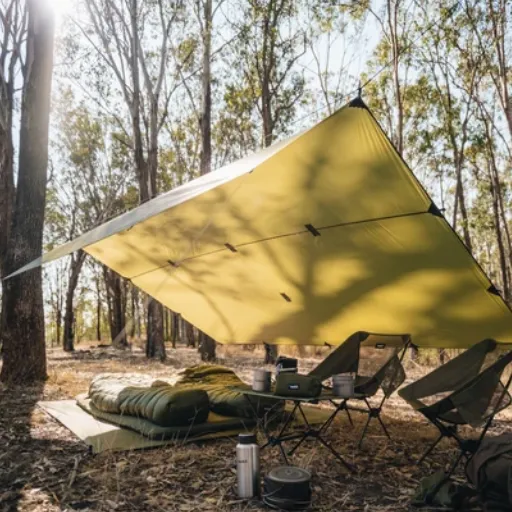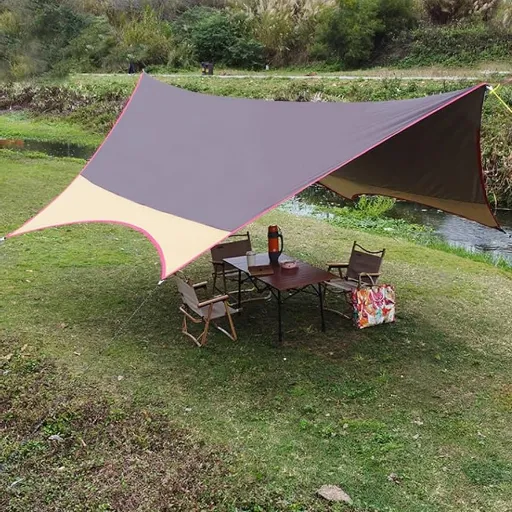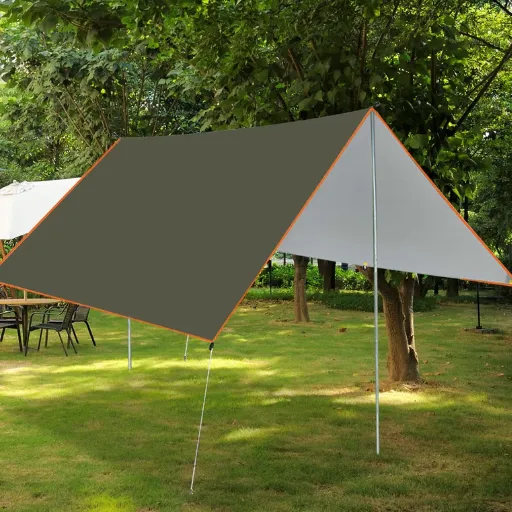
A heavy duty tarp for camping is a coated fabric of roughly 10 to 16 mil (about 180 to 300 GSM) with a tight weave, a rope-reinforced hem, and rust-resistant grommets every 18 inches. For most groups that means a 12 x 16 ft or larger polyethylene tarp; for basecamp and wind-driven sites, step up to PVC or a coated nylon shelter tarp.
Search “heavy duty tarp” and the same words return a 6-mil blue tarp from a hardware bin and a 900 GSM PVC membrane built for truck curtains. “Heavy duty” is not a standard. It is a marketing band, and every vendor redefines it to flatter whatever is on the shelf.
You already know what you want: a tarp that survives the trip without turning into confetti. This guide gives you the specification language to find it. We build tarpaulins for camps, farms, and construction sites, so we have no reason to push the most expensive option. See our complete guide to tarpaulin for camping for the full context.
Key Takeaways
- “Heavy duty” has no industry definition. Define it yourself with numbers: roughly 10 to 16 mil (180 to 300 GSM) over a tight, high-denier weave.
- Mil, GSM, and denier measure three different things. For PE tarps, GSM lands near mil × 17 to 20, so a 250 GSM tarp is about 11 to 12 mil.
- Heavy duty tarps fail at the grommets and hems, not the middle of the sheet. Rope-reinforced hems and reinforced corners matter more than an extra mil.
- Size by group and use, not by the largest number on the shelf. A 7 x 9 ft tarp covers three people; basecamp shelters run 15 x 15 ft and up.
- Heavy duty is the wrong purchase for backpacking. A 200 g coated nylon tarp beats a 10 lb poly tarp on any long carry.
What Makes a Tarp “Heavy Duty”? Mil, GSM, and Denier Explained
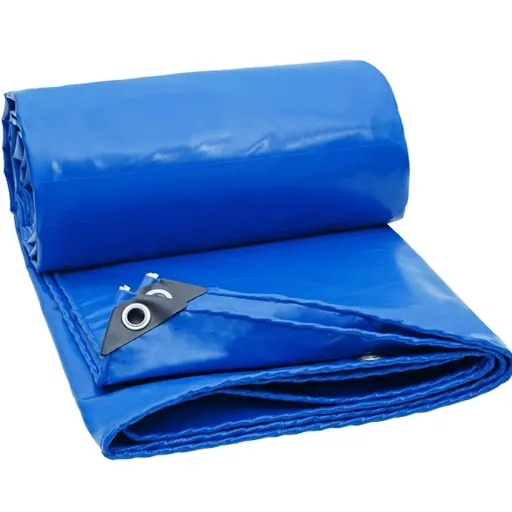
Heavy duty describes a coated tarp thick and dense enough to resist tearing, punctures, and UV breakdown through repeated outdoor use. In practice that lands around 10 to 16 mil over a tight weave. Because no standard governs the term, the numbers on the spec sheet matter far more than the words on the label.
Dan learned this the hard way. He bought a “heavy duty” tarp for a two-week family camp. It was 6 mil, the same grade as a paint drop cloth. The first storm stretched it, the second tore it at a corner grommet, and the family spent a night under a borrowed fly.
Mil, GSM, and Denier Measure Three Different Things
- Mil measures thickness. One mil is 1/1,000 of an inch, or 0.0254 mm. It describes the coating layer and is the headline spec on most retail polyethylene tarps.
- GSM measures mass per square meter. It weighs the finished fabric plus coating, which makes it harder to game than mil, so trade buyers specify GSM.
- Denier measures the thickness of the individual yarn strands in the base weave. Higher denier means stronger yarn, independent of coating thickness.
Why Weave Density Matters As Much As Thickness
Weave density describes how tightly the base fabric is woven. An 8 x 8 mesh is loose; a 14 x 14 or 16 x 16 mesh is tight. A tighter weave resists tearing and water penetration far better at the same thickness, which is often why two tarps at the same mil rating perform completely differently. Ask for the weave count before you ask for the price.
Heavy Duty Tarp Thickness and GSM: A Buying Chart
For a camping tarp, target 10 to 12 mil for three-season use and 16 mil for long-term or high-wind exposure. PE thickness and mass track closely, so a PE tarp at 250 GSM is roughly 11 mil.
| GSM | Approx. mil | Approx. oz/yd² | Duty Band |
|---|---|---|---|
| 80 | 3.4 to 3.8 | 2.4 | Light |
| 120 | 5.0 to 5.5 | 3.5 | General |
| 160 | 6.7 to 7.5 | 4.7 | Medium |
| 200 | 8.3 to 9.4 | 5.9 | Heavy |
| 250 | 10.6 to 11.8 | 7.4 | Extra heavy |
| 300 | 12.6 to 13.8 | 8.8 | Super heavy |
The conversion is a rule of thumb: multiply mil by 17 to 20 to estimate GSM for polyethylene. Two tarps at the same GSM can still differ in thickness once base fabric and lamination are counted, so specify both.
10 Mil vs 16 Mil: What the Difference Actually Buys You
Ten mil is the working definition of heavy duty in most retail lines: it survives a season of weekend camping and folds into a manageable bundle. Sixteen mil resists punctures and holds its shape better in sustained wind, but a 12 x 20 ft tarp can weigh close to 13 lb. Six mil is not heavy duty, no matter what the packaging says.
UV Treatment: The Spec Most Buyers Miss
Sunlight kills tarps faster than rain does. Without UV stabilization, polyethylene can lose more than half its tensile strength within 12 months of direct sun. A UV-stabilized tarp can last three to ten years; an untreated one may be brittle in a single season.
Ready to compare real specifications? Request a sample and spec sheet and we will send the GSM, denier, and weave figures for your shortlist.
What Size Heavy Duty Tarp Do You Need for Camping?
Size a camping tarp to your group and its shelter type, not to the biggest number available. Three people need at least a 7 x 9 ft tarp, and a basecamp for a group plus gear starts at 15 x 15 ft. The Backpacking Light community, which tests tarps season after season, converges on the same guidance: roughly 7 x 9 ft minimum for a small group shelter.
| Group Size | Use | Suggested Tarp Size |
|---|---|---|
| 1 to 2 | Sit-out shelter, cooking | 7 x 9 ft to 10 x 12 ft |
| 3 to 4 | Sheltered dining, gear cover | 10 x 12 ft to 12 x 16 ft |
| 4 to 6 | Family camp, shared lounge | 12 x 16 ft to 15 x 15 ft |
| 8 to 12 | Group and basecamp shelter | 15 x 15 ft to 20 x 13 ft |
| Any (groundsheet) | Footprint under a tent | Slightly smaller than the tent floor |
Our full camping tarp sizing guide breaks these bands down by weather and setup style if you are between sizes.
Cut Size vs Finished Size: Why Your Tarp Measures Short
The size on the label is the cut size, measured before the edges are hemmed. An 8 x 10 ft cut-size tarp finishes around 7 ft 6 in x 9 ft 6 in. On a large tarp a missing half foot rarely matters; on a compact tarp with a tight overhang it is the difference between dry and soaked. Order one size up, or confirm the finished dimensions first. Our standard tarpaulin sheet sizes list both figures.
For a groundsheet under a tent, bigger is worse: a footprint should sit slightly inside the tent’s floor outline, because an oversized tarp catches rain and channels it under the tent.
Heavy Duty Tarp Materials Compared: PE, PVC, Canvas, and Coated Nylon
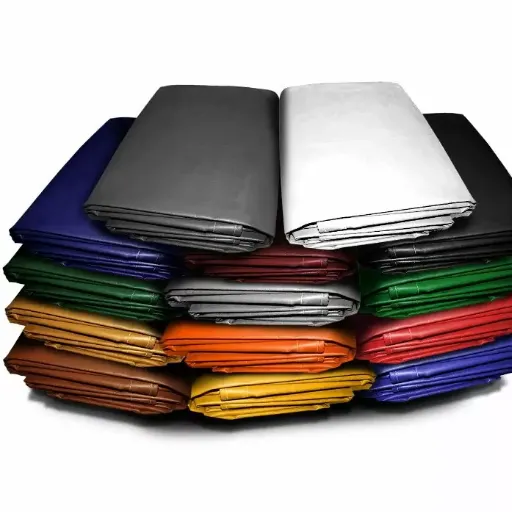
Polyethylene is the best value for most people. A 16 mil reinforced PE tarp does everything a car camper, family, or group needs at the honest best price. PVC is the most durable, canvas is quiet and breathable but only water-resistant, and coated nylon is the lightest heavy duty option.
Polyethylene (PE): The Budget Heavy-Duty Workhorse
PE is woven polyethylene coated on both sides: waterproof, inexpensive, and available in every size from 6 x 8 ft to 20 x 40 ft. Its weaknesses are weight, bulk, and noise, which matter little for car camping and basecamps.
PVC: The True Heavy-Duty Champion
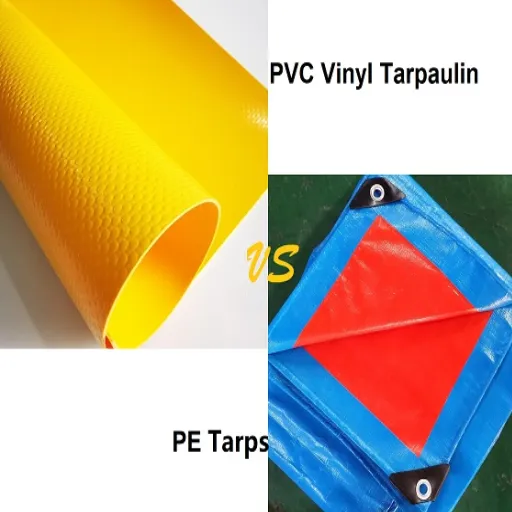
PVC resists abrasion and punctures better than PE and will not flap itself to pieces in sustained wind when tied down. A 600 to 650 GSM PVC tarp is built for repetitive use and rough handling; the trade-offs are cost and weight, making PVC a basecamp and group choice. See the detailed PE versus PVC comparison, or browse our waterproof tarpaulin range.
Canvas: Quiet, Breathable, Water-Resistant
Canvas is heavy, quiet in wind, and breathable, so it resists condensation better than plastic. The catch is that it is water-resistant, not waterproof: prolonged rain eventually soaks through, a wet canvas tarp becomes very heavy to pack, and it mildews if stored damp.
Coated Nylon and Oxford: The Lightweight Heavy-Duty Option
Tarps made from 70D to 210D ripstop nylon or Oxford polyester with a PU or TPU coating hit a different balance. A 70D ripstop nylon tarp can be waterproof to 20,000 mm with dozens of reinforced tie-outs while weighing under 10 lb; a 210D Oxford tarp with a 3,000 mm coating handles group duty under 5 lb. Choose these when you must carry the shelter, and pitch them clear of sharp branches.
Reinforcement: Where Heavy Duty Tarps Actually Fail
Heavy duty tarps rarely fail in the middle of the sheet. They fail at the grommets and hems, where every gust concentrates force on a single point of thin material.
A paddling group on the coast proved the point. In a storm, a cheap 9 mil silver tarp they had reinforced with rope through the hem held while higher-priced store-brand tarps shredded. The material was ordinary. The reinforcement was not.
Grommets, Corners, and the Rope-in-Hem
Quality heavy duty tarps place rust-resistant grommets roughly every 18 inches along the perimeter, with capped or aluminium hardware that will not stain the fabric, and reinforced corners that take the highest load. The single most effective reinforcement is a rope sewn into the perimeter hem: it spreads tension along the entire edge instead of pulling directly on one grommet, and it stops a tear from running. A rope-in-hem is standard on better tarps and absent on the cheapest ones, and fewer, wider-spaced tie-outs usually signals a weaker build, so ask if you cannot see the construction.
Heavy Duty Tarps for Basecamp, Groups, and Scout Troops
Group shelters must cover more people, withstand more wind across a larger sail area, and often stay identical across a fleet so a troop can replace one tarp without re-learning the setup.
A group leader we work with knew the problem well. Her scout troop’s tarps were all different sizes, bought piecemeal over years. Setting up camp became a negotiation every time, and replacing a torn tarp meant hunting down a model that no longer existed.
Group Specs and Procurement for Camps and Programs
For sit-down shelter, plan roughly 15 to 20 square feet per person; a 15 x 15 ft tarp shelters eight to ten people comfortably. Group tarps face higher wind loads because they present more sail area, so spec a tight weave, a rope-in-hem, and dense tie-out spacing, then pitch low and steep. Standardisation beats one-off buying for a camp, school, or troop: a single specification across a fleet means every volunteer already knows how to pitch it, and a replacement slots straight back in. We supply bulk tarpaulins for group camping in standardised sizes with optional branding, and our custom tarpaulin design service cuts to your exact footprint and MOQ.
Pitching a Heavy Duty Tarp for Wind and Rain
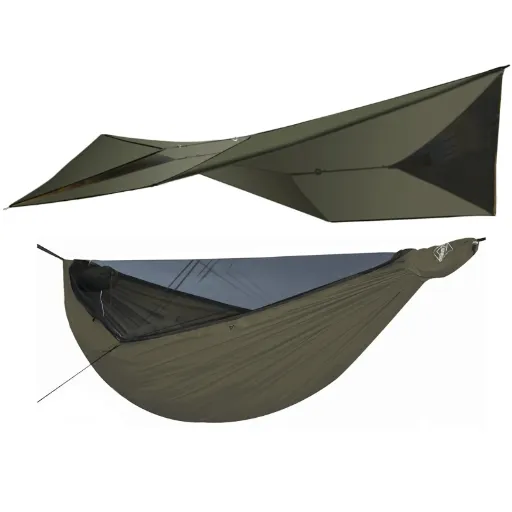
Most tarp failures are setup failures. Even a top-grade tarp pitched flat will pool water until it stretches and collapses, and one rigged drum-tight will tear in the first gust that adds load.
Slope, Never Flat
Water must have somewhere to go. Pitch the tarp with a clear high side and low side, and aim for a sidewall angle of roughly 25 to 30 degrees so rain runs off rather than collecting. Standing water is the leading cause of seam failure and collapse.
Firm but Flexible Tension
There is a difference between taut and rigid. A tarp tied drum-tight has no give, so a gust transfers its full force into the fabric and grommets. Leave a little slack and use guy lines or shock cord to absorb movement. Our camping tarp setup guide walks through ridgelines, pitches, and tensioning.
When a Heavy-Duty Tarp Is the Wrong Choice
A heavy duty tarp is the wrong purchase for backpacking and any camp where you carry your shelter. A reinforced 16 mil PE tarp can weigh 10 lb or more, and a 900 GSM PVC tarp is heavier still. Thick plastic is loud in wind and does not breathe. Buy heavy duty when you drive to the site, camp with family, or host a group; buy lightweight only when distance is the constraint.
Frequently Asked Questions About Heavy Duty Camping Tarps
How thick should a heavy duty camping tarp be?
Typically 10 to 12 mil for three-season use and 16 mil for long-term or high-wind exposure. Six mil is light duty, not heavy duty. Aim for roughly 180 to 300 GSM and confirm the weave count.
What is the difference between 10 mil and 16 mil tarps?
Ten mil is the common definition of heavy duty and handles weekend and seasonal camping. Sixteen mil is super heavy duty: it resists punctures and holds shape better in sustained wind, at the cost of weight, which can approach 13 lb for a 12 x 20 ft tarp.
Is GSM or mil a better measure of a tarp?
GSM is the better trade measure because it weighs the finished fabric and coating together, which is harder to game. Mil describes thickness only. For polyethylene, estimate GSM by multiplying mil by 17 to 20.
Is poly or canvas better for a heavy duty camping tarp?
Poly is better for most camping: waterproof, lighter, easier to clean, and cheaper. Canvas is quieter and more breathable but only water-resistant and very heavy when wet.
How long does a heavy duty tarp last?
A UV-stabilized heavy duty poly tarp lasts three to ten years with reasonable care. Without UV treatment, polyethylene can lose more than half its tensile strength within a year of direct sun.
The Bottom Line on Heavy Duty Camping Tarps
A heavy duty tarp for camping earns its name through measurable specifications, not the words on the label. Judge a shortlist on mil, GSM, denier, weave, and reinforcement, and the marketing falls away.
- Define heavy duty with numbers: roughly 10 to 16 mil, 180 to 300 GSM, over a tight weave.
- Reinforce before you upsize. A rope-in-hem and reinforced corners outlast an extra mil.
- Size to your group and use, and cut a tent footprint smaller, not larger.
- Match the material to the trip: PE for value, PVC for abuse, canvas for quiet, coated nylon for weight.
- Pitch with a slope and flexible tension, because most failures are setup failures.
If you are equipping a camp, a troop, or an outfitter’s fleet, we cut heavy duty tarpaulins to your exact footprint with standardised specs and optional branding. Get a quotation for your group, or learn how our products are manufactured in our tarpaulin factory.